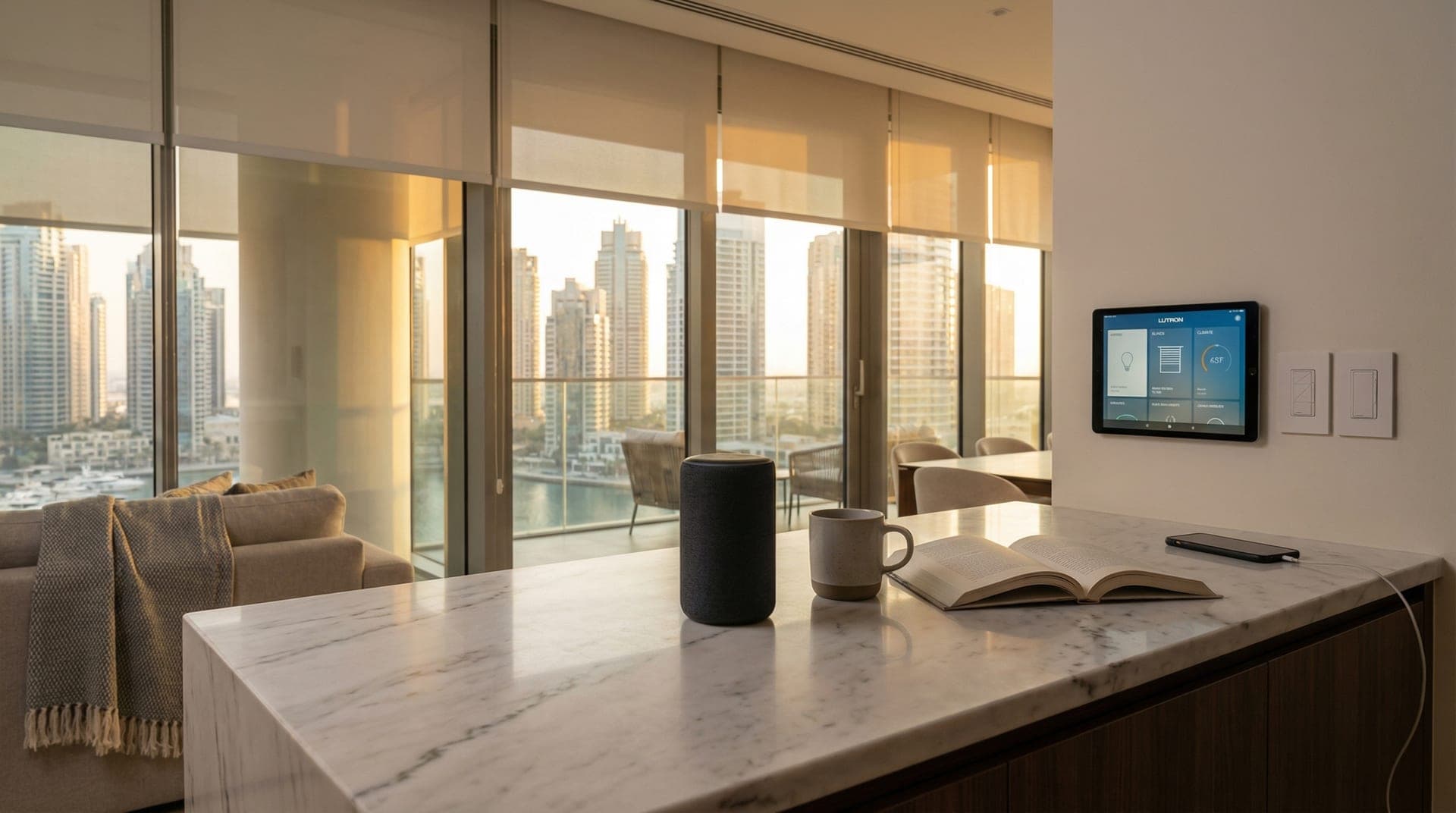
You bought an Echo. You asked Alexa to play Arabic coffee shop playlists while you cooked. You set a timer for your laundry. You asked about the weather even though it's Dubai and the answer is always "hot."
And somewhere in your head, a small voice said: "I have a smart home now."
You don't. You have a smart speaker. And in Dubai, where the smart home market is growing at over 10% per year (Renub Research, 2025), a smart speaker is to a smart home what a steering wheel is to a car. It's one component. Without the rest of the machine connected to it, it's a plastic circle that does nothing useful.
TL;DR: A smart speaker takes voice commands. A smart home responds to your life without commands. 70% of smart speaker owners only use them for music and weather. A real smart home connects your AC, lights, blinds, locks, and sensors so they work together automatically. Smart speakers can be the remote control, but they're never the whole system.
What Does a Smart Speaker Actually Do?
A smart speaker is a voice-activated assistant with a built-in speaker. It plays music, answers questions, sets timers, and reads the news. That's about 70% of what people use them for (SQ Magazine, 2026). Around 85% of Alexa users have set a timer. About 82% have asked it to play a song (Grabon, 2025). These are the two killer features.
When you ask Alexa to "turn on the lights," the speaker sends a command to a smart bulb over your WiFi network. The speaker is the messenger. The smart bulb is the thing that does something. Without the bulb, Alexa just says "I found a few devices, but none of them are set up." And that's where most people stop.
About 35% of Americans aged 12 and older own a smart speaker (SQ Magazine, 2026). But owning a speaker and having a connected, automated home are two different things entirely.
What Makes a Home Actually "Smart"?
A smart home is a system where devices talk to each other and respond to conditions without you giving commands. Your smart AC turns on 30 minutes before you get home because it knows your schedule. Your blinds close at 2pm because the sun hits your living room window at the same angle every afternoon. Your lights dim to warm tones at 9pm because that's when you usually wind down.
None of that requires you to say a word. The home runs on schedules, sensors, and automations. The voice assistant is one way to interact with it, but it's the least important part. Most automations should happen without any input from you at all.
In our experience, the clients who get the most out of their smart home barely talk to their speakers. The home already knows what to do. They use voice commands for the occasional one-off request, like playing a specific playlist or checking who's at the door. The automations handle the rest.
Why Do People Confuse Speakers with Smart Homes?
Marketing did this. Amazon, Google, and Apple all sell their speakers as the "gateway to the smart home." The packaging shows a person lounging on a sofa saying "Alexa, set the mood," and suddenly the entire room transforms. What the ad doesn't show is the 6-12 other devices that made that scene possible: the smart bulbs, the motorized blinds, the smart plugs, the hub, the configured routines, and the stable WiFi network holding it all together.
The speaker is the most visible part of a smart home because it sits on your counter and you talk to it. The actual smart home infrastructure - the controllers behind your AC vents, the sensors on your doors, the in-wall dimmers behind your light switches - is invisible. You never see it, so you forget it exists.
Consumer electronics like smart speakers account for about 37% of smart home device spending (Statista, 2025). The other 63% goes to the devices that automate your home: climate control, security, lighting, and sensors.
Can a Smart Speaker Control Everything in Your Home?
Technically, yes. Practically, no. A speaker can send commands to compatible devices. But "compatible" is the keyword. Your existing AC, blinds, and lights don't speak Alexa's language out of the box. You need controllers, bridges, and smart switches to translate between your voice assistant and your physical home.
For a Dubai Marina apartment, that means adding a smart AC controller to each unit (most apartments have 2-3 split ACs), smart bulbs or in-wall switches for lighting, and a smart plug or two for appliances. Then you need to configure routines, group devices by room, and test that everything responds correctly.
When we installed a full system in a Business Bay apartment last quarter, the client had already owned an Echo for two years. It sat on the kitchen counter playing podcasts. After we connected it to the rest of the home - smart AC, automated lights, and motorized blinds - she said: "I didn't know Alexa could do all that." Alexa always could. It had nothing to connect to.
What Does a Real Smart Home in Dubai Look Like?
Picture this. You leave your apartment in Downtown Dubai at 8am. A motion sensor notices the apartment is empty. Within five minutes, the AC switches to energy-saving mode, the lights turn off, and the blinds close to block the morning sun before it heats up your living room.
At 5:30pm, your phone's GPS crosses a geofence 10 minutes from home. The AC switches back to 22 degrees. The hallway light turns on. By the time you walk through the door, the apartment is cool, lit, and waiting.
You didn't say a single word to any device. You didn't open an app. The home knew your patterns and responded.
That's the difference between a speaker and a system. You talk to a speaker. A system already knows what you need.
A smart home starter setup begins at AED 3,000 installed, covering smart AC control with professional configuration and app setup. From there, you add layers: lighting scenes, security cameras and smart locks, motorized blinds, multi-room audio. Each addition makes the system more capable because the devices communicate with each other.
Does Everything Need to Be the Same Brand?
No, and this is where things have changed. The Matter protocol, now at version 1.5 with certified products from over 300 companies, was built specifically to solve the brand compatibility problem (Matter Smart Home, 2026). Device interoperability is expected to jump from 34% to 89% by 2026 as Matter adoption spreads.
What this means for you: a Philips Hue light, a Yale smart lock, and a Sensibo AC controller can all work together through Apple Home, Google Home, or Alexa without separate apps for each brand. The smart home industry spent years building walled gardens. Matter tears them down.
We build on open platforms for exactly this reason. If you decide to switch from Google Home to Apple HomeKit next year, your devices still work. No one should be locked into a single ecosystem because of the hardware in their walls. That's a principle we follow on every project.
How Do You Go from Speaker to Smart Home?
Start with the biggest annoyance. In Dubai, that's almost always the AC. You come home to a 34-degree apartment because you forgot to leave the AC running, or you left it running all day and your DEWA bill shows it. A smart AC controller solves both problems. It learns your schedule and pre-cools before you arrive, then dials back when you leave.
After AC, most people add lighting. A 3-scene lighting setup covers 90% of daily life: a bright scene for mornings and cleaning, a relaxed warm scene for evenings, and a dim scene for movie nights or winding down.
Then comes security. A smart lock means no more fumbling for keys. A video doorbell shows you who's there from anywhere. If you're renting, all of this installs without drilling, wiring, or landlord permission.
What we've found is that most people don't need a whole-home setup on day one. Start with the system that saves you the most daily friction. Let the rest follow when you're ready.
Frequently Asked Questions
Is Alexa or Google Home better for a smart home in Dubai?
Both work well as voice controllers, and both support the Matter protocol for cross-brand compatibility. Google Home integrates tightly with Android phones, while Alexa has the largest library of compatible devices. Apple HomeKit is the strongest option if you're an iPhone household. The voice assistant matters less than the devices connected to it.
Can I build a smart home without any voice assistant?
Yes. Every smart home automation runs on schedules, sensors, and app controls. Voice assistants are one interface, but you can control everything through your phone app or physical smart switches on the wall. Many of our clients rarely use voice commands because the automations handle their daily routines automatically.
How much does a full smart home cost in Dubai?
A starter setup with smart AC control begins at AED 3,000 installed. Multi-system setups covering AC, lighting, and security typically range from AED 8,000 to 15,000. Whole-home automation for apartments runs AED 10,000 to 25,000 depending on the number of rooms and systems. Villas with full integration can reach AED 25,000 to 50,000.
Do smart home devices work if my WiFi goes down?
Most devices continue operating locally during an internet outage. Schedules and automations you've already set keep running. Smart switches still work as physical switches. What you lose is remote access from outside your home and cloud-based voice commands. The Matter protocol was designed for local-first operation, so devices communicate directly with each other over your network.
Can renters in Dubai set up a smart home?
Yes. Most modern smart home devices are wireless, battery-powered, or plug-and-play. Smart AC controllers use adhesive mounting. Smart bulbs screw into existing sockets. Wireless cameras attach with magnetic mounts. Nothing requires drilling or wiring changes. Everything comes with you when you move to your next apartment. We've set up renter-friendly systems across Dubai Marina, JBR, and Palm Jumeirah with zero permanent modifications.
Your Echo is a good start. But it's a start, not a finish. If you want your home to actually run itself - not wait for you to ask it things - get in touch for a free consultation. We'll look at your apartment, tell you where to start, and give you a complete price. No pressure, no surprises.
Ready to Get Started?
Get a free consultation and we'll recommend what makes sense for your situation.
Get Free Consultation