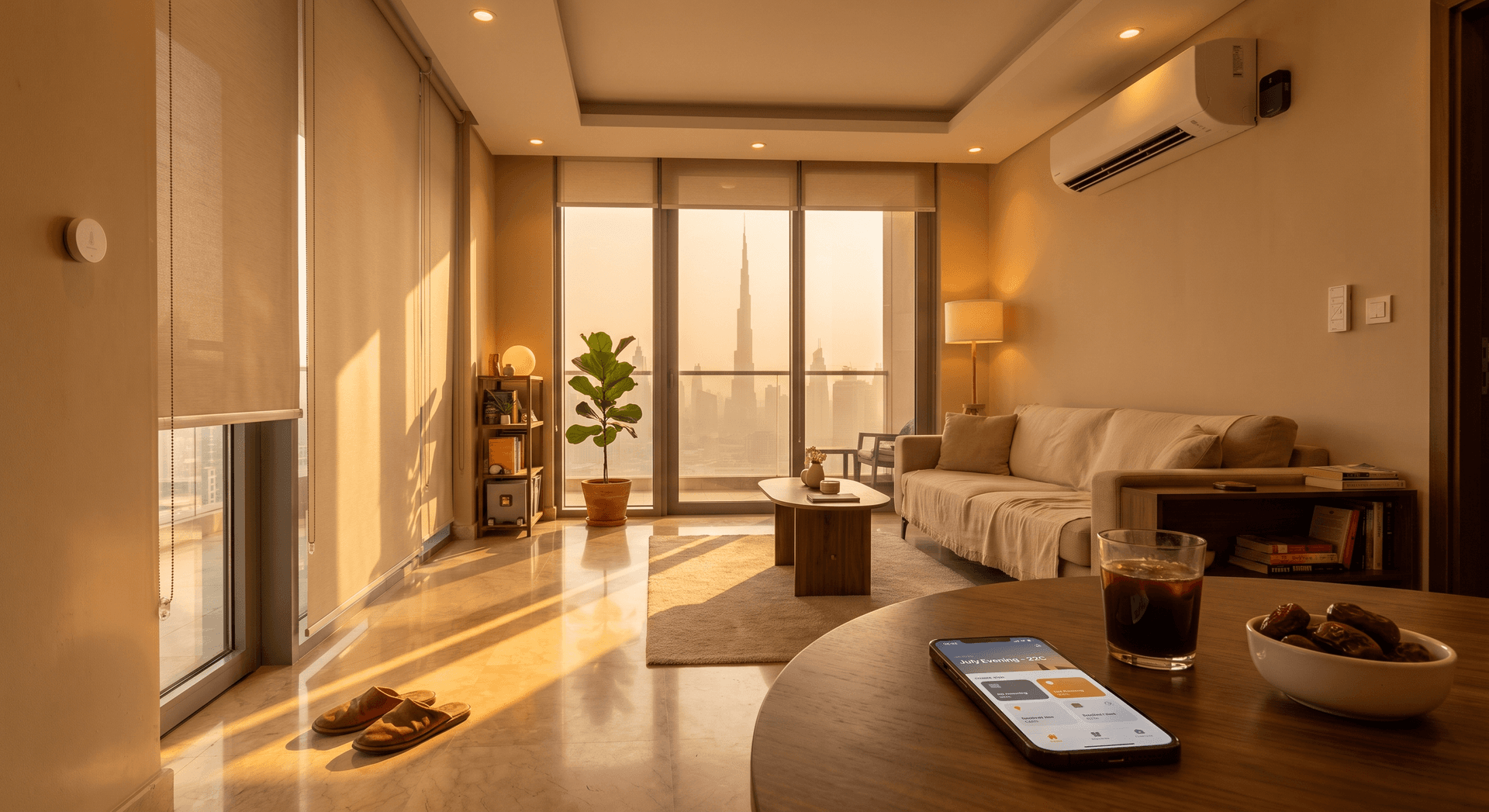
You step off the elevator. The hallway smells like recycled air. The apartment door swings open and the heat rolls out at you like a wall. It is 34 degrees inside at 7pm and you finished a full day of work in Business Bay. The AC remote is somewhere in the couch cushions. The blinds are open and the west-facing windows have been baking the living room for five hours.
July in Dubai does this. Every year. And every year, the question is the same: why does the apartment not know you are coming?
TL;DR: Dubai's July means 46C outside, the outdoor work ban in effect from 12:30 to 3pm, and DSS turning the city fully indoors. A smart apartment handles this differently: it pre-cools before you arrive, auto-closes the blinds against the afternoon sun, runs an evening scene without you asking, and manages overnight humidity without the AC slamming off at 3am. None of these require daily input. You set them once and they run.
The National Centre of Meteorology is forecasting temperatures reaching 46C this week, with blowing dust at gusts up to 40 km/h and humidity rising to 80% along the coast by night (Gulf News, 2026). That is the weather your apartment is dealing with right now. El Nino has a 98% probability of persisting from July through November 2026, making this potentially the hottest extended summer the UAE has recorded (Gulf News, 2026).
The outdoor work ban midday rule is already running through September 15 - no outdoor construction from 12:30 to 3pm (Gulf News, 2026). Global Village is shut. Miracle Garden is shut. The Mallathon has replaced jogging tracks with the mall atrium. Dubai Summer Surprises 2026 opens July 2, with up to 90% off across 1,500+ stores including electronics and homeware (Gulf News, 2026).
The afternoon belongs indoors. The question is whether your apartment is ready for that.
1. It Pre-Cools Before You Arrive
A smart July apartment is never 34 degrees when you walk in. It knows you are coming twenty minutes before you open the door, and it starts cooling down.
This is what location-based automation solves. Your phone's GPS creates a geofence around your building. When you leave the office and cross that boundary, your smart AC system triggers automatically, with nothing to open or configure. By the time you are in the elevator, the apartment has had fifteen minutes of active cooling.
The apartments we walk into in Business Bay and Dubai Marina are typically 4-8 degrees warmer than a correctly pre-cooled flat when residents arrive in summer. That gap represents forty minutes of standing around in an uncomfortable apartment, waiting for the AC to pull heat out of concrete walls that have been absorbing sun all day.
Concrete holds heat. Dubai apartments are almost entirely concrete construction. Once the walls heat up, the AC fights the building as much as the air. Pre-cooling before you arrive means the walls have had time to give up some of that stored heat. The difference is noticeable within a week.
The tool most people use for this is a Sensibo Sky (AED 350-450), which adds Wi-Fi and scheduling to any existing split unit. Sensibo's own data shows smart AC control reduces cooling costs by 15-25% compared to leaving units running all day or coming back to a hot flat and blasting 16 degrees until midnight (Sensibo, 2024). The savings on a Dubai summer DEWA bill are real - a 2-bedroom apartment in summer runs AED 600-1,000 per month on cooling alone (DEWA tariff data, 2026). Even a 15% reduction is AED 90-150 back per month.
2. It Closes the Blinds Against the Afternoon Sun
West-facing apartments in Dubai have a specific problem: direct sunlight hits the glass between roughly 2pm and 7pm in July. During those hours, every unshaded west-facing window acts as a solar panel pointed directly at your living room. The heat load on the AC doubles. The furniture fades. The room temperature climbs even with the AC running.
Sun-position automation for motorized blinds solves this without timers. Instead of closing at a fixed 3pm regardless of where the sun is, the system reads the real solar azimuth for your building's orientation and closes the blind the moment direct light crosses your glass. In July, that is around 2pm for most west-facing Business Bay towers. By September it shifts to nearly 3:30pm. The automation adjusts on its own.
What we have found is that residents with motorized blinds on sun-position schedules reduce their afternoon AC load enough that the DEWA savings across a summer are a meaningful offset against the installation cost. The calculation is straightforward: every hour of unshaded west-facing glass in 46C weather adds heat load that the AC has to remove. Remove the heat load and the AC runs less.
The apartments in JBR with full-height glazing facing the marina get this worst. Floor-to-ceiling glass and a west-facing marina view is beautiful at 6am and a radiator by 4pm. Smart blinds on a sun schedule change that without blocking the view during the early morning hours when the light is worth having.
3. It Runs the Evening Scene Without Asking
DSS runs Friday and Saturday evenings through July and August, which means more people hosting at home, more casual dinners, more friends over after a mall day. July nights in Dubai are pleasant if you are on a terrace or near the water - but they start with the apartment looking like a bright office and the AC still on blast from the afternoon.
A smart evening runs automatically. At 7pm, the lighting shifts to warm ambient, the AC eases to 23 degrees from the 20 it was holding during the hot afternoon, and if you have a Sonos setup, a playlist starts. You do not touch anything. Guests arrive to an apartment that already feels ready.
This is a scene - a single automation that changes multiple things at once. It is not complicated to set up. Home Assistant runs it in a single automation block. Aqara does it natively from the home app. The part people underestimate is how much mental load this removes from an evening. You come home tired. The apartment handles it.
In our experience installing smart homes across Dubai, the evening scene is the automation residents mention most in follow-up conversations. Not the geofencing, not the blinds - the moment they realized they had not touched a light switch in three weeks. That is when it stops being a technology project and starts being a home.
4. It Manages the Night Without Slamming Off at 3am
Dubai's coastal humidity at night rises to over 80% in July and August (NCM, 2026). When you run the AC on cool mode overnight, it pulls humidity out of the air as a side effect of cooling. When the AC hits its target temperature and shuts off to save power, the humidity comes back. Many people sleep through this cycle and wake up sticky at 3am wondering why the apartment feels damp.
Dry mode fixes this. Most split units have a dry mode that runs the compressor at low capacity specifically to control humidity, without aggressive temperature drops. A smart AC system can switch from cool to dry mode at midnight automatically, hold through the 3am humidity peak, and shift back to light cooling before your 6:30am alarm.
The result is uninterrupted sleep and a bedroom that feels fresh in the morning rather than close. DEWA bills also benefit: dry mode at low compressor load uses significantly less power than full cool mode cycling on and off through the night.
Pair this with an overnight scheduling block - cool to 23 degrees from 10pm to midnight, dry mode from midnight to 5:30am, then a gentle ramp back to 22 before your alarm - and you have a system that handles the night completely on its own.
What July Looks Like With These Four in Place
The day looks like this. You leave for work. The geofence detects you leaving and the AC goes to away mode - not off, not blasting, ticking over at 28 degrees to stay manageable. At 2pm, the blinds close on the west-facing windows without anyone asking. At 6:15pm, when you cross the geofence on the way home, the AC drops to 21 degrees. You walk in to a cool flat. At 7pm, the evening scene triggers. At midnight, the AC shifts to dry mode and runs quietly until morning.
You touched nothing. The apartment managed July on its own.
This is what home automation in Dubai looks like in practice: a home that manages the hard parts of summer without being asked.
Frequently Asked Questions
Does a smart home in Dubai have to be installed all at once?
No. Most residents start with a single automation - usually the geofence pre-cooling or the blind schedule - and add from there. A Sensibo Sky for the bedroom AC can be set up in an afternoon. Motorized blinds require installation but can be done one room at a time. The whole-home version is built incrementally.
Will smart blinds work in a rental apartment?
Yes, with one caveat. Motorized blind tracks replace the existing manual track and attach to the window frame, not the wall. This counts as furniture in most Dubai rental agreements, not a structural change. You take them with you when you move. We have installed in rental apartments across Business Bay, Marina, and JBR.
How much does it cost to pre-cool an apartment with smart AC versus running the AC all day?
Running a split AC at full blast from 8am is the most expensive cooling habit in summer. On a DEWA summer tariff, every hour of unnecessary runtime adds up - and coming home to a hot flat and slamming the unit to 16 degrees until midnight compounds that. Smart pre-cooling runs the AC for the 20-30 minutes it needs before you arrive, rather than all day or in a panic at arrival. The Sensibo Sky that enables this costs AED 350-450.
Does the evening scene automation require expensive equipment?
No. A basic evening scene controlling one AC unit and one smart bulb group costs under AED 1,000 in hardware. Aqara G2H Pro hub plus an Aqara smart switch for lights runs around AED 400-500 all in. The automation logic is free inside the hub's app. The higher cost comes when you add multi-room lighting with dimming, motorized blinds, and Sonos integration - that is a full home automation project, not a starter kit.
Is 80% humidity at night normal in Dubai in July?
Yes, particularly for coastal apartments in JBR, Marina, and waterfront buildings. The NCM monitors show coastal humidity regularly exceeding 80% on summer nights when sea breezes push marine air inland (NCM, 2026). High-floor interior apartments in Business Bay or Downtown tend to see lower overnight humidity but still experience the 3am AC cycling issue. Dry mode overnight is useful in both cases.
July does not have to be three months of coming home to a warm flat and waiting for the AC to catch up. The tools to solve this have been available for a while. The missing piece is usually the setup.
If your apartment is not handling summer on its own yet, get in touch and we will look at it with you. We work across Business Bay, Marina, JBR, and most of the major Dubai residential towers. The conversation is free and we will tell you exactly what makes sense for your setup, not a package.
Ready to Get Started?
Get a free consultation and we'll recommend what makes sense for your situation.
Get Free Consultation