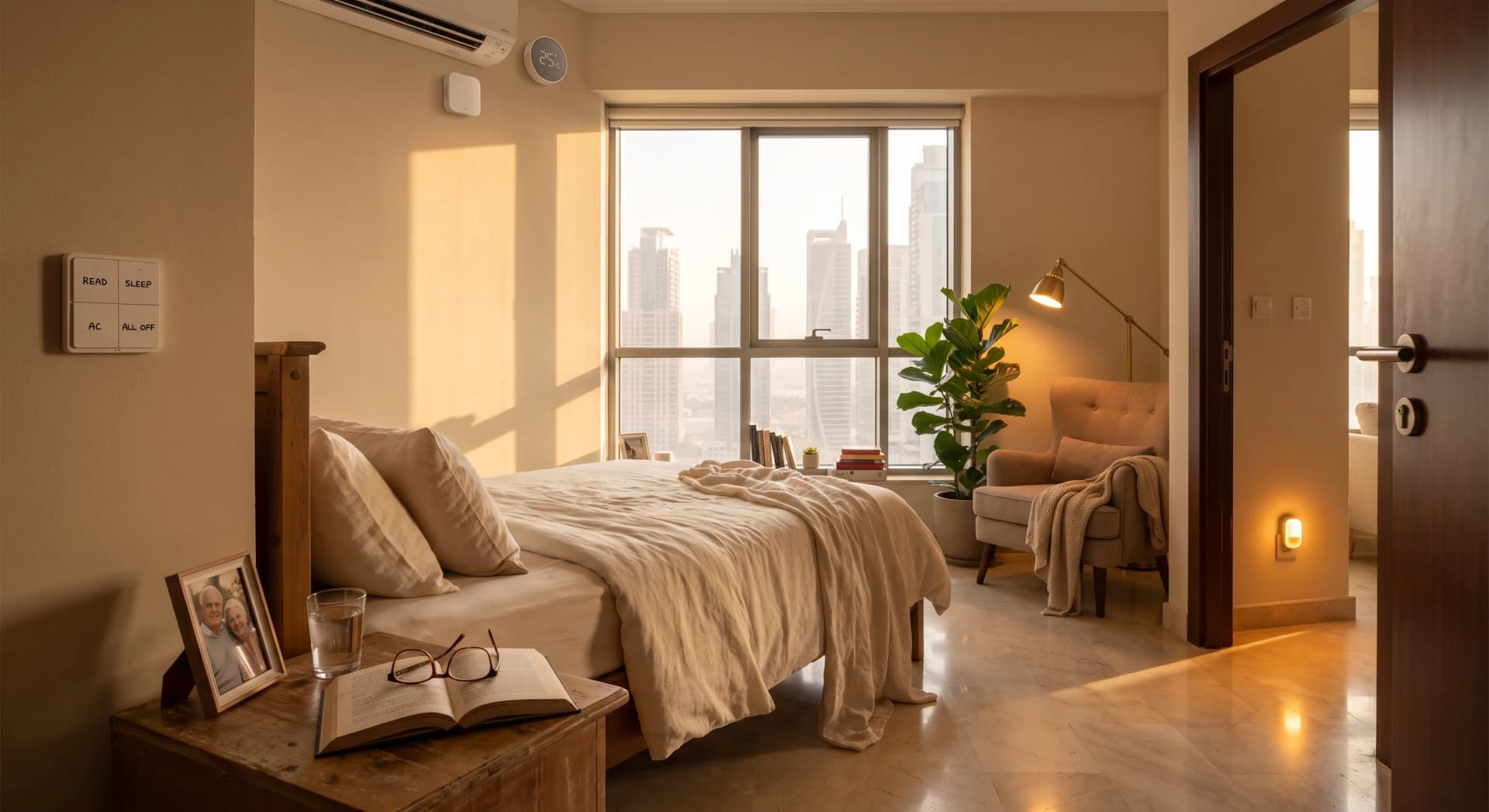
Your mother is staying for the summer. She has the second bedroom. You leave for the office at eight, and because everyone in Dubai has been told the AC is what runs the bill up, she turns it off during the day to be helpful. By two in the afternoon her room is thirty degrees. She does not mention it, because she does not want to be a bother, and honestly she does not fully register how hot she has gotten. Then at three in the morning she gets up for the bathroom, in the dark, in a room she has been in for two weeks and still does not know by heart.
Neither of those is a comfort problem. They are the two things that most often go wrong for an older person at home, and they are exactly the two things a smart home is good at removing. This is not about convenience for her. It is about the room not being able to fail her while you are not there.
TL;DR: For an aging parent in a Dubai apartment, the two real risks are heat and the dark. Start with a smart AC controller on their room that holds a temperature floor so it can never be left off in a 44C summer, from AED 3,000. Add a motion-lit path from bed to bathroom so there is no switch to find at 3am. Give them one wall button or voice, never an app. Skip the camera in their room. The whole thing is care, not surveillance.
Why an Aging Parent Is a Different Problem, Not a Smaller One
Most smart home advice assumes the person using it is you: someone who wants a nicer evening, a lower bill, a home that feels finished. An older parent needs none of that. They need the ordinary small failures of a home to stop being dangerous.
Two facts make the difference concrete. As we age, the body regulates temperature less efficiently, with reduced sweating, less blood flow to the skin, and, the part people miss, a reduced ability to even notice getting too hot (Cahoon Care, 2026). And falls are the leading cause of injury-related death among adults over 65, with about one in four experiencing a fall each year (U.S. News, 2026). Put those in a Dubai apartment in July and you have a room that can overheat someone who will not feel it, and a dark hallway between them and the bathroom at 3am. The devices below are the same ones we install for anyone. Pointed at these two problems, they stop being nice-to-have.
The AC Controller Is the First Thing, Not the Lighting
For an aging parent, the highest-priority upgrade is a smart AC controller on their room that holds a temperature floor, so the AC can never sit off through a 44C afternoon. It starts from AED 3,000 installed and it is the single change that removes the most risk.
Here is why it beats everything else on the list. Air conditioning is the most effective defense against heat there is, but for an older person AC alone is often not enough, because when indoor humidity climbs above 60% even a room at a comfortable temperature can leave them overheating and unable to regulate (Senior Safety Advice, 2026). Dubai delivers exactly that combination in summer: overnight coastal humidity runs 80 to 90% from July through September. So the controller does two jobs. It holds a floor, meaning the room is not allowed to climb past a set point like 25C no matter who turned what off, and it watches humidity and flags it when the air gets heavy even though the temperature looks fine. She never has to touch it, and it cannot be switched off into a dangerous state. When we set this up in Business Bay apartments, the parent's room stops being the hottest room in the home by mid-afternoon, which is usually the first thing the family notices.
A Lit Path From Bed to Bathroom, On by Itself
The second thing to build is an automatic light path from the bedroom to the bathroom, low and warm, that turns on when they move and off when they settle. Proper automated lighting can cut fall-related injuries in older people by up to 50% (A Healthy Senior, 2026), and of all the automations you can add, this one does the most.
The reason is the specific moment it fixes. An older person wakes at 3am needing the bathroom, groggy, eyes not adjusted to the dark, and reaches for a switch they cannot find in an unfamiliar room. That fumble, in the dark, with urgency, is where the fall happens. Motion sensors along the route from the bed to the door to the bathroom remove it entirely: soft light appears the moment their feet hit the floor and traces the way, then fades once they are back in bed (ComForCare, 2026). It is deliberately dim and warm so it does not jolt them fully awake. In our experience this is the change parents comment on unprompted, because for the first time the trip to the bathroom stopped being something they brace for.
One Button They Will Actually Use, Never an App
Give an older parent one physical control, a wall keypad or their voice, and never expect them to open an app. This is the difference between a system that gets used and an expensive one that gets ignored.
A parent who has spent seventy years with light switches is not going to learn a phone app, and a wall touchscreen with menus is worse, not better. What works is a simple keypad by the bed with a few clearly labelled buttons: one for comfortable, one for reading, one for the night path, one for off. Press one, the room does the right thing. If they prefer talking, an Aqara or voice-assistant command does the same job. One thing families always ask is whether their parent will accept any of this, and the answer is that they accept it precisely because there is nothing to learn. We keep their old light switch by the bed too, and put the automation underneath it, so nothing they already trust gets taken away. The technology should disappear. She should just have a room that behaves.
How to Know They Are Okay Without a Camera in Their Room
The way to check on a parent during the day is a quiet presence signal, not a camera. A door or motion sensor can tell you on your phone that they are up and moving this morning, without ever putting a lens in their private space.
This matters more than it first looks. A camera in a parent's bedroom or bathroom is the wrong tool for the job, it is intrusive in a way that erodes their dignity, and under Dubai's rules on recording it is a bad idea anyway (privacy and the local camera rules are worth reading before you point a lens anywhere). What you want to know is simpler than video: is mum up, has she moved through the apartment this morning, is everything normal. A motion sensor in the hallway that pings you when there is activity before nine gives you that. No footage, no watching, only presence. If there is a genuine fall history, that is the point to talk about more, but for an independent parent who is otherwise fine, presence sensing does the reassuring job without the surveillance. Bayora sets these to notify you, not to record them.
What a Real Setup Looks Like in a Business Bay Apartment
A working couple in a 2-bedroom Business Bay apartment host the wife's mother, who is 72, every summer from June to August in the second bedroom. Before, the AC in her room was switched off through the workday to save the bill, so it hit thirty-plus by afternoon, and she would not say anything. The night trip to the bathroom was in the dark.
We put a smart AC controller on her room holding a 25C floor with a humidity flag, motion sensors and two warm night lights on a bed-to-hall-to-bathroom path, and a four-button keypad by her bed. We also set a quiet morning ping to the daughter's phone: motion in the hall before nine means she is up. Total came to around AED 4,800. The room now never climbs past 25C, the path lights itself, the daughter stopped texting to ask if her mother was coping with the heat, and the July electricity for that room came in lower than the previous year, because holding a room steady costs less than letting it reach thirty and then hauling it back down. The savings were a side effect. The point was that nobody was worrying.
What Bayora Will Talk You Out Of
We would rather scope this down than sell you a package your parent will not use, so a few things we routinely tell families to skip.
Skip the wall touchscreen. At AED 1,200 and up it is money spent on something a parent will never learn; a simple keypad or voice does the job for less. Skip the camera in their room, for every reason above. Skip cooling the whole apartment harder to be safe, because the waste is in the empty rooms, not the safety; their room and the night path are what matter. Skip the medical-alert pendant subscription if the person is independent and just needs the environment fixed, and add monitoring later only if there is a real reason to. And do not rip out the routine they trust. The goal is a room that quietly takes care of the two things that go wrong, not a tech project imposed on someone who did not ask for one. If the honest answer is that AED 3,000 of AC control solves 80% of the risk, that is what we will tell you.
Where to Start
Start with the AC controller on their room, because it removes the most risk for the least money and it can be doing its job the same week. That is the smart AC control piece, from AED 3,000, and for many families it is the whole project.
Add the night path next, then the one-button control, then the presence ping, in that order, because that is the order of how dangerous the gap is. None of it requires drilling or landlord permission, and it comes off cleanly when the summer ends or the tenancy does, which is the same reason smart AC works for renters generally. If you want the wider picture of what a sensor-led home looks like, the Aqara sensor layer guide covers the building blocks, and the summer-at-home security setup covers the rest of the family. This is close to the same instinct behind keeping a pet comfortable while you are out: someone you love is at home while you are not, and the home should look after them.
Frequently Asked Questions
What is the most important smart home upgrade for an elderly parent in Dubai?
The smart AC controller on their room. In a 44C summer, an older person can overheat without feeling it, and a controller that holds a temperature floor means the AC can never be left off into a dangerous state. It starts from AED 3,000 installed and removes the single biggest risk before you spend on anything else.
Do I need a camera to keep an eye on an aging parent at home?
No, and in their bedroom or bathroom you should not use one. A motion or door sensor can tell you on your phone that they are up and moving, which is the thing you want to know, without putting a lens in their private space. It is presence, not surveillance, and it respects their dignity and the local rules on recording.
Will an older parent be able to use smart home controls?
Yes, because the right setup gives them nothing to learn. One wall keypad with a few labelled buttons, or a plain voice command, replaces the app entirely. We keep their existing light switches in place and add the automation underneath, so nothing they already trust is taken away. The technology disappears and they get a room that behaves.
How much does it cost to set up a Dubai apartment for an aging parent?
A single room done properly, meaning AC control, a lit night path, and a simple keypad, typically lands between AED 3,000 and AED 5,000. The AC controller alone starts at AED 3,000 and solves most of the risk. Everything is removable, so it suits a rented apartment or a parent who stays only for the summer.
Does holding the AC on all day cost more on the DEWA bill?
Usually less, not more. Holding a room at a steady temperature costs less than letting it climb to thirty degrees through the day and then cooling it back down every evening. In the apartments we set up this way, the parent's room often comes in lower than the prior summer, and the safety is the actual point.
Ready to make a parent's room quietly take care of them? Tell us about your apartment and we will recommend where to start, usually the one upgrade that matters most, with no obligation.
Ready to Get Started?
Get a free consultation and we'll recommend what makes sense for your situation.
Get Free Consultation