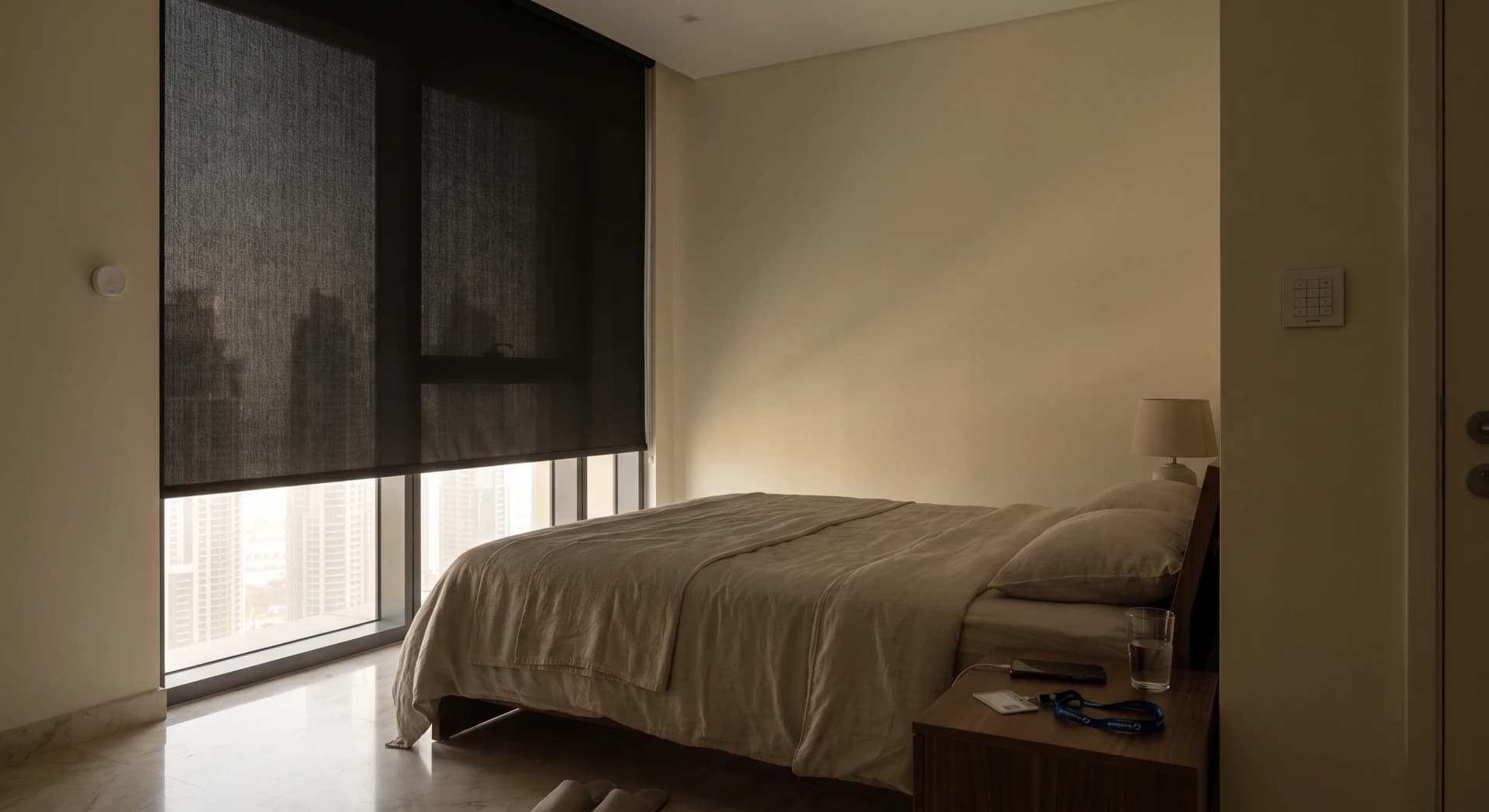
You finish at seven in the morning. The city that kept you working all night is only starting to wake up. You get home, and the apartment that is supposed to be your recovery room is doing everything wrong at once. The bedroom is bright. It is already warming up. Downstairs a delivery bike is idling and somewhere on your floor a drill has started. You need to be asleep in twenty minutes and awake again by mid-afternoon, and the building has no idea.
Dubai runs on shift work. Hospitals, hotels, the airport, security, broadcast, building management, on-call engineering. A huge share of this city earns its living at night and tries to sleep through the day. The problem is that almost every apartment here was set up for the opposite life. Your home assumes you sleep when it is dark and wake when it is light. When you invert that, the house works against you. This is where a smart home earns its keep. It gives you back the hours the flat would otherwise steal.
TL;DR: Daytime sleep in a Dubai summer fights you on three fronts at once: light, heat, and noise all peak during the exact hours you need to be asleep. A smart home closes a blackout blind on your schedule instead of the sun's, holds the bedroom cool through the hottest part of the day, masks the noise you cannot stop, and silences your own home's interruptions with one tap. It will not soundproof a wall or make you a morning person. A blackout blind, AC control, and one "day sleep" scene is the honest place to start, from around AED 3,000.
Daytime sleep in Dubai is a harder problem than it looks
Daytime sleep is a different problem from night sleep. Your body clock is built to keep you awake while it is light, so daytime rest is genuinely harder to hold. It shows up in the numbers: roughly 18.5% of night shift workers meet the diagnostic criteria for insomnia, against 8.6% of day shift workers (Sleep Foundation, 2025).
In Dubai, the summer stacks two more problems on top of the body clock. The heat and the noise both peak in the middle of the day, which is the middle of your sleep. So a night worker here is not fighting one thing. They are fighting daylight, outdoor highs that reached 46 degrees in Dubai this August (Khaleej Times, 2026), and a building at its loudest, all inside the same six hours. Fix them one at a time.
Darkness is the first fix, and it runs on your clock
The single biggest lever is light. In our experience it is the hardest thing to get right, and the room has to be genuinely dark, not dim. The standard advice is blunt: blackout curtains or thick coverings will keep most outside light out (Sleep Foundation, 2025). A clip-on blackout curtain does part of the job, but it leaves a bright gap down each edge, and at 8am in a Dubai summer that gap is a strip of hard light across the bed.
A fitted blackout roller closes that gap. The part that matters for you is the schedule. A normal smart blind closes at sunset. Yours needs to close at 8:30am and open at 3:45pm, on your rota, not the sun's. In our experience setting these up in Business Bay towers, inverting the schedule is the whole trick. The blind treats your sleep window as its "night." Everything downstream, the AC and the lights, follows the same inverted clock.
The room has to be coldest when the day is hottest
The cruel part is the overlap: your sleep window in summer sits right on top of the hottest hours, so your AC has to work its hardest at the exact time you need the room stable. Your core temperature naturally drops about two hours before you fall asleep, which is part of how sleep starts (Sleep Foundation, 2025). A room drifting warmer works directly against that.
The range most experts land on is roughly 15.6 to 20 degrees Celsius (Sleep Foundation, 2025). A smart AC controller does two useful things here. It pre-cools the bedroom before you get home, so you walk into a room that is already ready instead of one you have to wait forty minutes to cool. Then it holds that setpoint through the day rather than letting the flat creep up while you are asleep and unable to notice. One thing clients always ask is whether it is wasteful to cool a bedroom hard at 2pm. It is far less wasteful than cooling the whole apartment, which is what most people do because the only control they have is the master remote.
Masking the noise you cannot stop
Noise is the front where honesty matters most. A smart home cannot soundproof your wall. If there is construction next door or a drill two floors up, no automation removes it. What helps is masking. A steady, even sound raises the floor so that a sudden bang does not spike above it and jolt you awake. In a study of healthcare shift workers, noise-masking earbuds may improve reported sleepiness, tension, and sleep quality (JMIR Formative Research, 2022). A smart speaker running a fan or rain track does the same job for the room instead of your ears.
The bigger win is quieter and often overlooked. Your home makes its own interruptions, and those you can switch off. The advice to keep things quiet during the day (Sleep Foundation, 2025) includes the noises you are generating without realizing. A smart lock can let the housekeeper or a courier in without anyone leaning on a doorbell that rings through the flat. You are home. You are just asleep, and the house should know the difference.
Invert the whole house with one scene
Setting a blind, an AC, a speaker, and a doorbell one by one, every single day, is its own small tax on a tired brain. The point of a smart home is that you stop doing that. You build two scenes and press one button.
A "Day Sleep" scene, triggered at 8:30am or by a tap when you walk in, does the lot at once: blackout blind down, AC to your sleep setpoint, bedroom lights off, a soft masking track on, doorbell chime muted, phone-triggered alerts around the house paused. A "Wake" scene at 3:45pm reverses all of it, easing the light back up so you do not surface into a black room and a jolt. When we set the good night routine up for a night-shift nurse in a tower flat, what she told us afterward was that she had stopped managing her own bedroom and got to fall into it.
What to skip
The honest recommendation for a night worker is to spend on the three things that move sleep and ignore the rest. You do not need a smart mattress, a wearable that scores your sleep, or an AED 1,500 sound machine with a subscription. A phone plays the same masking track for free. You do not need to wire the whole apartment. The bedroom is the only room that has to run on your inverted clock; the rest of the flat can stay on a normal schedule.
If your problem is solved with a blackout blind, an AC controller, and a scene, that is what we will quote. We have talked more than one shift worker out of a whole-home project they did not need and into a single-room setup that fixed the actual problem. Start with the bedroom blind and the climate control, and add from there only if you want to.
Where to start
If you are renting, everything above works without touching the walls or asking a landlord. A battery blackout roller, a plug-in or clip-on AC controller, and a smart speaker cover it, and they come with you when you move. Plan on around AED 3,000 for the bedroom, installed and configured. If you own and want the scenes to run harder, wired blind motors and a proper controller give you more, but the renter setup is where almost everyone should begin.
For the full range of what a bedroom climate setup involves, our guide to smart AC control walks through it, and for the light side, the wake and wind-down scenes piece covers matching the lighting to your body clock.
Frequently Asked Questions
How do I sleep during the day in Dubai when the apartment is noisy?
You cannot stop the noise, but you can mask it and stop adding to it. Run a steady fan or rain track on a smart speaker to raise the sound floor so sudden bangs do not jolt you, and mute your doorbell chime and phone-triggered home alerts during your sleep window so your own house stops waking you.
Do blackout blinds actually help you sleep during the day?
Yes. A genuinely dark room is the biggest single lever for daytime sleep, because daylight is the thing most likely to keep you from dropping off. A fitted blackout roller beats a clip-on curtain because it closes the bright gap down each edge, and on a smart schedule it drops for your sleep window rather than at sunset.
Will cooling my bedroom every afternoon spike my DEWA bill?
Cooling one bedroom to a sleep temperature draws far less than cooling the whole apartment, which is the usual habit when the only control is the master remote. A scheduled setpoint that runs during your sleep window and eases off when you wake keeps the draw contained. A lower bill is a side benefit here, not the reason to do it.
Can I set my AC and blinds to close on my shift schedule?
Yes. A smart controller lets you invert the normal logic so the blind, AC, and lights treat your daytime sleep window as their "night." You set the times to your rota, or trigger a "day sleep" scene with one tap when you get home, and reverse it with a "wake" scene in the afternoon.
I am renting. Can I do this without my landlord's permission?
Yes. A battery blackout roller, a clip-on or plug-in AC controller, and a smart speaker need no wiring, no drilling, and no approval, and you take them with you when you move. A bedroom setup like this starts from around AED 3,000 installed and configured.
Work nights and want your apartment to finally cooperate with your sleep instead of fighting it? Tell us about your place and we will recommend the smallest setup that fixes the real problem. No obligation, no surprises.
Ready to Get Started?
Get a free consultation and we'll recommend what makes sense for your situation.
Get Free Consultation