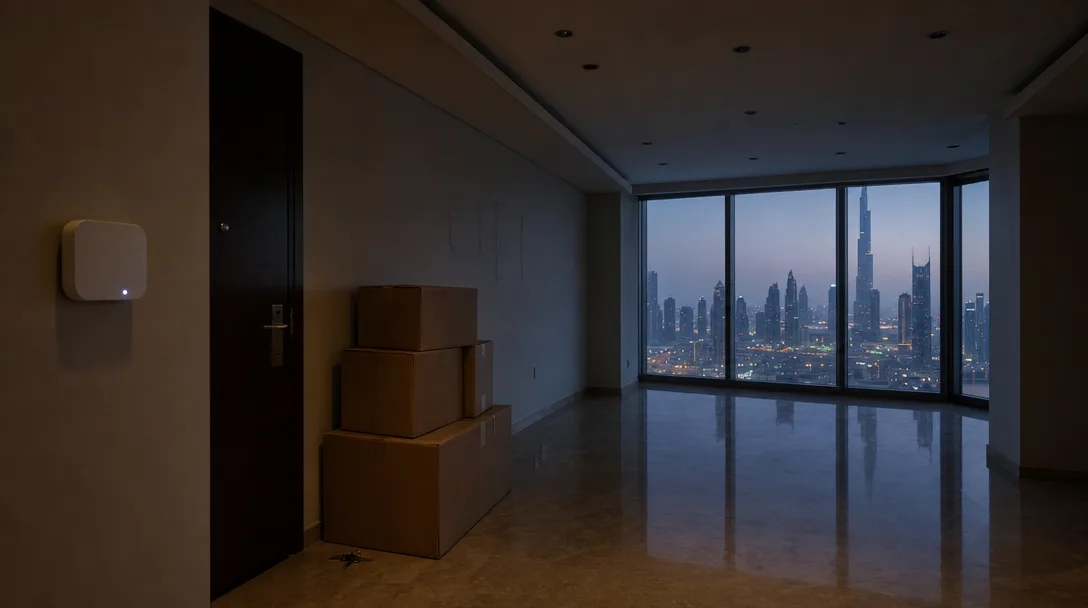
The buyer gets the keys, the access cards, and an electronic title deed. Then she walks into the apartment for the first time as its owner, puts her bag down, and reaches for a light switch that does nothing she expects. The ceiling is full of smart downlights. There is a small white box on the wall by the entrance. Every one of those devices is now legally hers, and not one of them will answer her phone, because all of them are still paired to an account belonging to someone who has already moved out.
This is the quietest failure in a Dubai property sale. Nobody lies, nobody breaches anything, and the deal completes exactly as written. The hardware changes hands. The control does not.
TL;DR: When a Dubai home sells, the fixed devices go with the property but the account that runs them does not, and the standard contract has no field for it. Handing it over takes one conversation before transfer day. Skip that, and the buyer is pushed into factory resets and manufacturer consent flows that can lock them out for weeks.
Ready homes change hands here in the thousands. More than 3,400 of them did so in Dubai during July 2026 alone, according to consultancy Cavendish Maxwell (Economy Middle East, 13 August 2026). A decade ago inheriting a home meant inheriting a curtain rail and a water heater. Now it increasingly means inheriting a hub, a lock, a doorbell, and a ceiling full of addressable lights.
The Account Is the Part That Does Not Transfer
Losing access to a home and losing control of a device are not the same event, and the gap between them is where handovers go wrong. Platforms differ in how a device gets claimed in the first place, but they all draw that line somewhere, and neither the seller nor the buyer usually knows where.
Apple says it outright on its own support page about sharing a home: "If you remove someone from your home in the Home app, they might still be able to control accessories." It continues that this happens when the removed person has permission in a separate app, and that removing those permissions means going to the accessory's own app or the manufacturer (Apple Support).
Google documents the mirror image, and it is the trap a considerate seller falls into. If you remove yourself from a Google home, Google's page on people and permissions states that other people no longer have access to the devices or services you set up, naming thermostats, alarms, locks and cameras. Google also states that if you are the only member of the home, the home gets deleted along with its data (Google Nest Help).
So a seller who tidily removes themselves from the home on the way out has not cleaned up. Google names a handful of exceptions on that same page, mostly its own speakers, displays and Wi-Fi hardware, but the thermostats, locks and cameras the seller set up go dark for the person left behind. They have taken the house's memory with them. This is the same single-account problem that bites households long before anyone sells, which we wrote about in everything in the house is in one person's account.
What a Factory Reset Costs You
It costs you the design, and the design is the part somebody paid for. Where the big platforms document a handover at all, it is usually not a transfer. Google Nest and Philips Hue both publish the same three steps: remove it from the account, factory reset it, then start again.
Google's own moving guide is written for exactly this moment and tells you to remove the device and then factory reset it, with the warning attached: "This action will clear your data from the device and can't be undone" (Google Nest Help).
Philips Hue lists selling or giving away your Bridge as one of the situations that calls for a reset, and is honest about the price of it. Signify's page states that after a reset, all your personal configurations, linked lights, and automations will be erased, and that everything has to be reconnected through the app afterwards (Philips Hue).
That erasure is easy to underrate, because the lights still switch on. What dies is the rooms, the groups, the scenes, the sunset routine, the way the hallway comes up at ten percent at night instead of full brightness. The bulbs survive. The design does not.
Cameras and locks are worse, because they are built to resist exactly this kind of takeover. Google warns that a Nest camera already used by another account cannot be added until the existing video history expires, and states plainly: "This can take up to 60 days, but may happen sooner."
Tuya, the platform a lot of own-brand devices are built on, has a name for this shape of lock-in. It calls it strong binding: a device has to be unbound from the account holding it before any new account can bind it. Tuya concedes the cost in its own developer documentation, which says strong binding increases the difficulty of transferring devices, and that in the case that page documents, returned stock, each one has to be unbound individually (Tuya Developer). That page is written for the brands building on Tuya rather than for homeowners, and Tuya describes strong binding as widely used in cameras and recorders rather than universal across its range.
Locks Are the One That Ruins a Move-In Day
Yale publishes a support article for the previously-owned case and it is the clearest statement of the problem any manufacturer has put in writing: "Previously-Owned Yale Smart Locks need to be factory reset before they can be set up by a new owner." If the lock reaches you unreset, Yale will ask the previous owner for permission on your behalf.
Two separate sentences on that page set the clock. It may take up to 30 days for the previous owner to respond to the request, and the request expires after 30 days. Read together, that means a previous owner who simply never answers runs the window out without ever saying no. Yale also suggests contacting the seller directly to speed the process up, which works only if you still have a number that still works (Yale Home Support). Get that number before transfer day, not after.
igloohome documents the same shape: unpair from the old account, register the new one, pair again, and if you do not have the original account details, the company requires authorisation from the original account owner (igloohome Support, last modified 2020).
And there is a last detail people discover at the worst possible moment. On the Aqara U100, the manual states that resetting clears the previous user settings, and then adds that the door lock cannot be locked normally until a new owner is added in the app. Resetting a lock and stopping there does not leave you with a dumb lock. It leaves you with a door.
If you are choosing hardware with any of this in mind, our guide to smart locks for Dubai apartments covers the models that are common here.
What the Law Settles, and Where It Stops
The fixed parts of a smart home generally stay with the house, and the statute reaches further than most people expect. Article 470 of the UAE Civil Transactions Law is direct about the easy half: "A contract relating to a house includes the immovable fixtures therein, but not the movable items, unless the purchaser stipulates their inclusion in the contract."
The more useful article is 103, because it answers the objection everybody reaches for first. "A movable placed by its owner on an immovable owned thereby for the purpose of serving or exploiting such immovable shall be deemed immovable by destination, even if it is not permanently affixed to the immovable."
Whether something unscrews is not the test. A hub sitting on a shelf, dedicated to running the home it sits in, is not obviously a lamp you pack. We are not a law firm and this is not legal advice, and we have not tested that reading against any UAE court ruling. But the statute leans further towards "it stays" than the market assumes, and under Article 470 it is the buyer who has to write something into the contract to pull a movable in.
One housekeeping note, because it catches people. The current instrument is Federal Decree-Law No. 25 of 2025, in force since 1 June 2026, and it replaced the 1985 Civil Code. Most of the article numbers still circulating in property commentary online point at the repealed law. The official text is published in Arabic with an English translation, and the portal states that the Arabic prevails where the two differ (UAE Legislation).
Here is where the law stops being useful. It governs the objects. It has nothing to say about the account.
The Standard Contract Has No Field For Any Of This
DLD publishes the standard sale agreement, Form F, as a five-page PDF. Search the whole document for fixture, fitting, inventory, appliance, equipment or contents and you get nothing. There is no schedule and no annexure. What it has instead is an as-inspected standard, in Clause 20: the buyer acknowledges that he inspected and previewed the property and agreed to buy it in its current condition (DLD sale agreement template).
There is also no official snagging or handover-inspection step anywhere in DLD's resale process. Snagging in Dubai is a private-market habit, not a registered procedure. So for a resale, the only place a smart home can be described at all is the free-text conditions box in Form F, or a separate agreement between the parties.
Nobody is going to prompt you for it. If the system is worth having, it is worth a line.
What We Saw In an Apartment Where It Went Right
A client took over a Dubai apartment running an Aqara hub with ninety Zigbee devices on it: downlights, spotlights, lightstrip drivers, floodlights, curtain controllers, wall switches. Before we ever arrived, access had already been settled with the previous owner. He could see the whole system and switch things on and off from his own account before we walked in. What he could not do was build a scene, change the colour temperature, or make anything happen by itself, which is why he called us.
Because access was already settled, that job was an audit, a rename of every device by room and function, rooms and groups, scenes, a handful of background automations, and a walkthrough. We booked it as a short evening visit.
The other version of the same job was written into our own scope sheet as an exclusion, quoted separately, and it reads: factory reset and re-pairing of all ninety devices, if the previous owner is unreachable. That is not an evening. It is a full day on site, and at the end of it the apartment has ninety working devices and zero of its old behaviour.
What we have found on a separate villa job is that the information gap is the one nobody plans for. The client could not tell us where the doorbell chime was. The wiring suggested there had once been two. He said he would ask the previous owner. A smart home carries a lot of knowledge that lives in nobody's app: which breaker feeds the garden lights, which switch was replaced, where the hub is plugged in, who fitted it.
The Seller's List, Before Transfer Day
Do this while you still care, which is to say before you have moved out and stopped answering messages.
- Write down what is in the home. Not a brochure list, a real one: how many lights, the hub and where it is, the lock, the doorbell, the cameras, the blinds, the AC controllers. This is also the document that stops an argument about what was in the apartment on the day it was inspected.
- Decide what you are taking, and say so before signing. A plug-in speaker and a portable AC controller are the ones nobody argues about. A hub screwed to the wall running the whole flat is a different conversation, and neither Article 470 nor Article 103 is obviously on the side of the person who unscrews one quietly on the last morning. Put it in writing before the contract is signed rather than leaving it to be argued after.
- Hand over the account with the buyer in the room. Add them on the platform as an admin, not just a member, have them accept on their own account, and have them prove from their own phone that they can control the things that matter. Then remove yourself while they are still standing there, which is safe now because the buyer is on the home as an admin, so you are not the last one and nothing gets deleted when you go. Let them re-add whatever drops out. On Google that drop is documented rather than hypothetical, so expect it and reset what has to be reset while you are both there. The state you are aiming for is a home the buyer owns outright with you not on it at all.
- Reset the devices that hold personal data, on purpose. Locks, cameras and doorbells carry old access codes and recordings, and they should not travel with your account still on them. Reset those deliberately, with the buyer present if you can. Do not blanket-reset the lighting or the climate system on your way out, because that is the part you are handing over, not the part you are erasing.
- Hand over the boring knowledge. Where the hub lives, which app runs what, what the automations do, what the Wi-Fi situation is. If the home was professionally installed, give them the installer's number. If it was assembled over three years from four different brands, say that too, because it changes what the new owner should expect.
The Buyer's List, Before You Sign
- Ask what platform it runs on, then ask who owns the account. Those are two questions and the second one matters more. A system whose logic runs locally in the home survives a change of owner better than one living inside somebody's personal cloud login, because there is less that has to be released by a person who has stopped answering. That is the case for an open platform, and it is a reason we favour one. It is also not what most homes here are running, including plenty we have installed ourselves, and including the ninety-device apartment in the case above.
- Ask for the handover to happen before the money moves. Once the deal is closed you are asking a favour. Before it closes you are agreeing a term.
- If it is wired in, name it in the contract. A few screw-in smart bulbs are replaceable for the price of the bulbs. Wall switches, a hub, motorised blinds and a lock are not, because somebody opened the wall to put them there. Anything in that second group belongs in the conditions box rather than left to the standard form, which does not cover it.
- Test the lock yourself, with your own phone, on your own account. Do it before you rely on it. It is the single device where a failed handover locks you out of your own property rather than merely annoying you.
- Get the seller's number and keep it. Half the fixes in this article require a person who answers. That person becomes much harder to reach the week after completion.
If you have taken over a home and the system is intact but unreadable, that is a configuration job rather than a rebuild, and our post on what to set up in the first week is a reasonable starting order. Renting rather than buying puts you in a different position entirely, which we covered in moving out of a Dubai rental.
Frequently Asked Questions
Does a smart home stay with the property when you sell in Dubai?
The fixed parts generally do. Article 470 of the UAE Civil Transactions Law keeps immovable fixtures with a house and leaves movables out unless the buyer stipulates otherwise, and Article 103 counts a movable that serves the property as immovable even when it is not affixed. That is our reading of the statute, not legal advice.
Can you transfer a smart home account to a new owner?
It depends on the platform, and a clean transfer is rarer than people expect. Google Nest and Philips Hue both document remove-then-factory-reset instead. Adding the buyer as an admin before you go beats leaving them nothing, but Google warns that once you remove yourself they lose whatever you personally set up.
What if the previous owner will not reset the smart lock?
Yale will ask them for you. Two separate sentences on Yale's page set the timing: the previous owner may take up to 30 days to respond, and the request expires after 30 days. An owner who never answers runs it out without ever refusing. Yale also suggests contacting the seller directly to speed things up.
When should the seller reset the smart lock?
On handover day, with the buyer there, not the week before. On some locks a reset leaves the door degraded until a new owner is added. Aqara's U100 manual, for one, says the lock cannot be locked normally after a reset until a user is added in the app.
Is a smart home worth anything when you sell in Dubai?
There is no reliable Dubai-specific figure for this, and we would rather say so than borrow a number from a UK or US survey and present it as local. A system handed over intact and documented is an asset. The same system handed over locked is a cost.
Nobody cheated the woman standing in her own dark apartment. The one part of the house that needed a conversation never got one, and after transfer day that conversation gets a lot harder to have.
Buying or selling a home in Dubai with a system already in it? Tell us what is installed and we will tell you what transfers, what needs resetting, and what it takes to get it running under your own account.
Ready to Get Started?
Get a free consultation and we'll recommend what makes sense for your situation.
Get Free Consultation