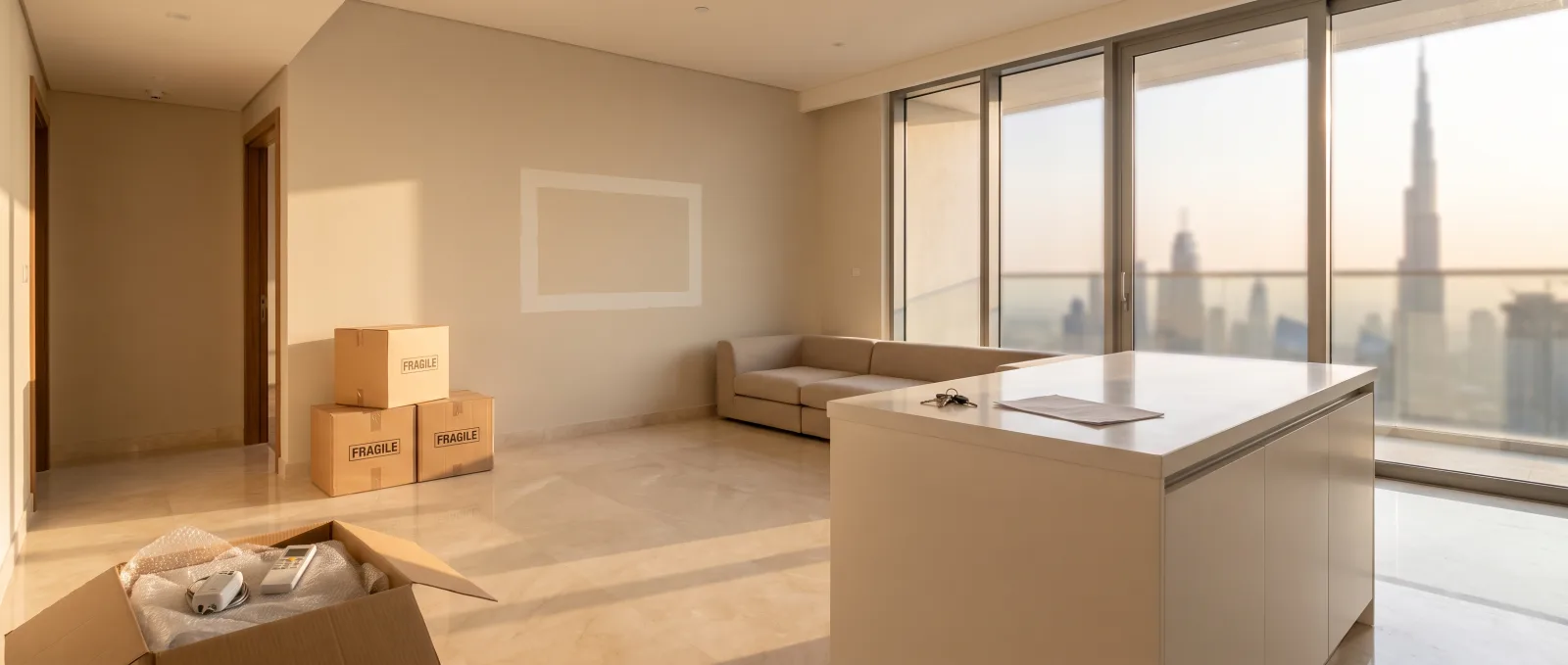
You spent two years teaching this apartment how you live. The AC starts cooling the bedroom before you leave the office. The lights drop to something warm at nine. The lock lets your cleaner in on Tuesdays and nobody else, ever.
Then you sign somewhere new, and all of it becomes a problem. Some of it is screwed to a wall you do not own. Some of it is paired to a hub that is going in a box. And one of the accounts you are about to walk away from still has a live video feed of a living room that will belong to a stranger in three weeks.
TL;DR: Check your contract's vacate-notice period first, because the 90-day rule you have heard of is not what you think. Anything that clips, plugs, or sticks comes with you. Anything you wired in stays, unless you and the landlord agreed otherwise in writing. Close DEWA, then district cooling, then Ejari, in that order.
Check Your Notice Period Before Anything Else
Open your tenancy contract and find the vacate-notice clause. That number, not a number you read online, is what governs when you have to tell the landlord you are leaving.
This matters because the famous 90-day rule is widely misdescribed. Article 14, as replaced by Law No. 33 of 2008, sets 90 days as notice to amend the terms of a lease ahead of renewal, a rent increase being the usual reason. It does not oblige a tenant who simply lets the term expire to announce anything. Older copies of the 2007 law still show the pre-2008 wording, which is where most of the confusion comes from.
The reason it still binds you is that Article 14 opens with "unless otherwise agreed by the parties," and nearly every Dubai tenancy contract inserts a vacate-notice clause of its own. So the number is real. It just comes from your contract rather than the law, and it is sometimes 60 days rather than 90.
Dubai's Default: What You Installed Stays With the Flat
The default in Dubai is that what you installed stays. Article 23 of Law No. 26 of 2007 reads: "Unless otherwise agreed by the parties, upon vacating and surrendering possession of the Real Property, the Tenant may not remove any leasehold improvements made by the Tenant."
Read that again, because it runs against the instinct. You bought the smart switches. You paid the electrician. And on the plain wording of the statute, absent an agreement to the contrary, you do not have the right to take them out on the way out.
Two things narrow it. It applies to improvements, meaning things that became part of the property, so a plug-in sensor was never in scope. And it opens with "unless otherwise agreed by the parties," which is the whole game.
Worth being precise: we have not found a published Rent Dispute Settlement Centre decision applying Article 23 to smart home hardware specifically. What we can say is what the statute says by default, which is enough to change how you install in the first place.
What Comes With You, and What Does Not
Ask one question of every device: did installing it need a screwdriver or a wire? If not, it was never a leasehold improvement, and it leaves in a box with nothing owed.
Comes with you:
- Smart AC controllers that stick beside the unit and talk to it by infrared
- Curtain and blind motors that clamp onto an existing rod or track
- Plug-in smart plugs, shelf-standing cameras, battery sensors, hubs, speakers
- Retrofit locks that mount over existing hardware without changing the cylinder
- Bulbs, as long as you take the bridge and reset them first, covered further down
Counts as an improvement, and stays unless you agreed otherwise:
- Smart switches that replaced the original wall switches
- Anything wired into a ceiling, including in-ceiling speakers and hardwired blind motors
- Wall-mounted keypads and panels
- Relay modules added inside the fuse box
Keep the original switch plates in a labelled bag from day one. They go in the bin on a Saturday afternoon and nobody remembers them eighteen months later. Nothing else here costs so little and saves so much argument.
What You Must Restore, and What You Do Not
A scuffed skirting board is wear and tear and you are not liable for it. Four screw holes and a missing switch plate are a change you made, and you are.
That is the line Article 21 draws. It requires the tenant to "surrender possession of the Real Property to the Landlord in the same condition in which the Tenant received it," allowing for "ordinary wear and tear or for damage due to reasons beyond the Tenant's control." Practically, unrestored changes are what a landlord deducts from your security deposit at handover, which is the part that stings.
Article 19 decides which side of the line you are on: a tenant may not make changes "unless so permitted by the Landlord and after obtaining required licences from the competent official entities." Two requirements, not one. In practice that bites on mains electrical work and almost nothing else. Clipping on a controller or mounting a motor on a curtain rod is not licensable work. Swapping live wall switches is where you want a licensed electrician, which is worth doing anyway.
One article cuts the other way and almost nobody quotes it. Article 18 says the landlord "must provide the Tenant with the approvals required" for works needing official approval, as long as they do not affect the structure and you bring the paperwork requesting them. Asking permission to install is not asking a favour.
Photograph every room at move-in and again at handover. Disputes about deposit deductions go to the Rent Dispute Settlement Centre, not to the landlord's judgement, and photographs are what turn an argument into a fact.
The Agreement That Changes the Default
If you want the right to take hardwired equipment with you, what you need is one short written agreement. Something close to this, agreed by email or attached to the tenancy:
The following devices remain the property of the Tenant and may be removed by the Tenant at the end of the term: [list them]. The Tenant will reinstate the original fittings and restore the property at the Tenant's own cost.
That is the "otherwise agreed" Article 23 asks for. Your agent or the landlord's may want to word it their own way, which is fine, as long as the two things above survive: the devices are yours, and you restore what you remove. Landlords often say yes, because a written schedule removes their risk as well as yours. Without one they are weighing a tenant who installs nothing at all, or a tenant who installs and leaves a restoration argument behind at handover.
If you already installed and you are moving in three weeks
Ask now, in writing, and you may still be fine. Article 23 does not require the agreement to have existed at the start of the tenancy, only that the parties agreed. A landlord's written yes today is as good as one from two years ago, so send the message.
Lead with the offer to reinstate the original fittings at your cost, because that is what they actually care about. If the answer is no, the switches stay with the flat and that is the end of it. You are not liable for anything further on hardware you are leaving behind, and the deposit exposure is about restoration, not about the devices themselves.
This is the question that changed how we scope renter work. We now treat "what happens to this when the lease ends" as part of the install decision rather than an afterthought, because the less you hardwire, the less any of this matters at all. Our guide on smart home devices Dubai renters can take when you move covers the gear that never creates the problem, and smart AC for renters covers the highest-impact one.
The Three Accounts You Close, and the Order
DEWA first, district cooling second, Ejari last. Nothing formally blocks a different order, and DLD does not ask for a DEWA clearance certificate to cancel Ejari. Running it this way just means you are never settling a utility bill on a lease you have already dissolved.
DEWA
Submit the move-out request through the DEWA app or website under Supply Management (Gulf News, August 2026). You pick a disconnection slot, settle the balance, and choose how the deposit comes back. Both clocks then run from that same slot: deactivation within 24 working hours of it, and the final bill within 24 working hours of it. Per DEWA there are no move-out disconnections on Sundays or public holidays, so a Sunday handover needs a Saturday slot.
The charge is AED 125 for a small meter and AED 300 for a large one, plus AED 10 knowledge and AED 10 innovation fees. The DEWA deposit is AED 2,000 for an apartment and AED 4,000 for a villa (Gulf News, October 2025). It offsets against your final bill and the balance returns to your IBAN. The most common reason a refund stalls is the beneficiary name on the IBAN not matching the name registered with DEWA.
Once the final bill is settled the clearance certificate is issued automatically and shared with both you and RERA. It is valid for 30 days, so do not collect it months early.
District cooling
This is the account people forget, and it keeps billing after DEWA is closed. If your building runs on Empower, Emicool, or Tabreed, your cooling never appeared on the DEWA bill and closing DEWA does not touch it. The account stays in your name until you file a separate settlement request, and the cooling deposit is separate from and additional to the DEWA one.
Empower handles it through My Services, then Settlement Request, on its e-services portal. If you have never had to think about this split, district cooling and why it sits outside your DEWA bill explains it.
Ejari
Leave this until the utilities are settled. It is free through the Dubai REST app or the Ejari system on the DLD website, or AED 40 plus VAT at a Trustee Centre. Either party can apply, despite the common claim that only landlords can.
There is no cancellation certificate. Once it completes, the lease is simply invalid. If an agent asks you for one, it does not exist.
De-Registration: The Step That Matters Most
Before a single device goes in a box, remove it from your account. This gets skipped because nothing prompts you: everything works right up until you hand over the keys.
Locks
Codes and fingerprints live on the lock itself, so deleting the app changes nothing. Aqara is blunt about what a proper reset does to its U-series locks: it wipes every stored code, registered fingerprint, and all settings, and removes the lock from connected ecosystems (Aqara). Skip it and every credential you ever enrolled is still live on that door: yours, your partner's, the cleaner's, the one you gave a delivery driver in 2025 and forgot.
August and Yale locks need more care, because the next occupant cannot reset one alone. Yale needs permission from the previous owner before it will reset a lock on someone else's behalf, it emails that person to ask, and the request expires after 30 days (Yale). Leave one behind unreset and the next tenant is waiting on an email to someone who has left the country. So do it while the lock is still yours: remove it from your account in the app, run the hardware factory reset, and only then take it off the door. Our guide to how smart locks actually work covers where each type keeps its credentials.
Cameras
The binding survives your move, and the risk runs both ways. Ring says it plainly: "Canceling your Ring subscription, physically uninstalling the device, or deleting the Ring app will not release ownership" (Ring Support). Taking a camera off the wall is not giving it up. Leave one behind still linked to you and you keep a live view into a home that is no longer yours.
The next tenant cannot simply adopt it either. Google's remedy is for the previous owner to log in and delete the camera. If that person is unreachable, a camera set up in the Google Home app can be factory reset and re-paired, but on the older Nest-app cameras there is no such escape: the new occupant waits for the previous owner's video history to expire, which takes up to 60 days (Google Nest Help). Delete the device from your account before you go and none of this is anyone's problem.
Philips Hue and the Bulbs That Stop Working Without You
Leave Hue bulbs in the ceiling and take the bridge, and the next tenant inherits lights that only answer the wall switch. The bulbs are paired to a bridge that now lives in your new apartment, and nobody can adopt them until they are reset.
The fix costs five minutes and has to happen before you unplug anything. Delete each light from the bridge while they are all still talking to each other, through Settings, then Lights, then Delete (Philips Hue).
Do it in the wrong order and recovery gets tedious. Hue's alternative routes need either the six-digit serial printed on the bulb, which on a fitted ceiling downlight means a ladder, or a Hue dimmer held near the light, which means leaving an accessory behind you meant to pack. If the bridge is staying too, unlink it from your Hue account first, then hold the recessed reset button on its back for five to ten seconds. Account first, hardware second.
The same logic covers any hub-and-accessory system. Sensors, buttons, and motors paired to an Aqara hub, or to whichever hub runs them, are inert without it. The hub travels with them or it stays with them.
Your Wi-Fi Password Is Still Inside Half of These Devices
Every device you set up stored your network credentials. Speakers, plugs, cameras, controllers, and hubs all hold the name and password of the network in the flat you are leaving, and a factory reset is the step that clears them.
Most people skip it. Researchers at Northeastern University bought 86 used Amazon Echo Dots and found that "a surprising number of devices (61%) were not reset by the previous owners" (Giese and Noubir, WiSec '21). The same paper found that on those Echo Dots, passwords and tokens could survive on flash memory even after a reset.
So reset every device, and then do the one thing entirely inside your control: change the Wi-Fi password when you move, and do not reuse the old apartment's network name and password at the new address. A device holding credentials to a network that no longer exists is holding nothing worth having.
This advice is specific to moving. If you are staying put and only the hardware is changing, the opposite applies and you want to keep the old network name and password, which we explain in the new router arrived and half the house stopped answering.
That matters most for anything you sell or give away, and in Dubai that usually means Dubizzle. Reset before it leaves your hands, even for a device going to a friend, and reset anything you are leaving in the flat for the same reason. One detail worth getting right: do the reset while the device is still on the old apartment's Wi-Fi, so the change reaches the vendor's servers rather than sitting on a device that never reconnects.
While you are there, remove the home itself. Apple Home, Google Home, and Alexa each keep a home object with rooms, routines, and invited members attached. Leaving the old one live and building a second at the new address is how people end up with automations firing against an address they left, and with a former flatmate still listed as an invited member of a home they cannot see.
The Move-Out Sequence, in Order
Working backwards from handover day:
- Check the vacate-notice clause in your contract and serve notice to that date.
- Three weeks out, decide device by device what leaves, what stays, what gets restored. If anything hardwired is coming out, get the written agreement and book the electrician now.
- One week out, de-register everything from your accounts. Locks and cameras first. Factory reset each device as you remove it, not in a pile at the end.
- Handover week, submit the DEWA move-out request with a slot that is not a Sunday, file the district cooling settlement separately, and photograph every room and every wall you touched.
- After the final bill, collect the DEWA clearance certificate, check the IBAN name matches, then cancel Ejari.
- At the new place, rebuild deliberately rather than restoring a backup. Your first week in a new Dubai apartment covers the order that works.
Frequently Asked Questions
Can I take my smart switches with me when I leave a Dubai rental?
On the wording of the statute, only if you agreed that in writing. Article 23 of Law 26 of 2007 says a tenant may not remove leasehold improvements on vacating unless the parties agreed otherwise. A written yes from the landlord at any point counts, so it is worth asking even late.
Do I need to close my district cooling account separately from DEWA?
Yes. Empower, Emicool, and Tabreed are separate companies with separate accounts and separate deposits. Closing DEWA does not touch them, and a cooling account left open keeps billing in your name after you have gone.
How long does a DEWA deposit refund take when moving out?
Usually minutes. DEWA has cut this repeatedly over the past year, and as of April 2026 processes refunds up to AED 4,000 in about eight minutes, covering roughly 90 per cent of all requests (Khaleej Times, April 2026). Since the apartment deposit is AED 2,000, most move-outs fall inside that. Larger refunds and accounts still carrying a balance take longer.
What happens to smart bulbs if I take the hub?
They stop being smart. Bulbs paired to a bridge you remove only answer the wall switch until someone resets them. Delete each light from the bridge before you unplug it. Recovering them afterwards needs the serial number printed on the bulb or a Hue accessory held nearby.
Can the next tenant see my old camera footage?
No, your stored recordings stay tied to your account. The real risk runs the other way: a camera left in the flat and still linked to your account gives you a live view of someone else's home. Delete the device from your account before handover.
Leaving One Dubai Apartment and Setting Up the Next
Most of what you built can move with you. The parts that cannot are usually a smaller job than they look three days before handover, and they are almost always settled by a conversation you either had or did not have before installing.
If you are moving within Dubai, we can look at what you already own, what is worth bringing, and what the new place actually needs. No obligation, and no pressure to replace things that still do the job.
Book a free consultation and we will map it out with you.
Ready to Get Started?
Get a free consultation and we'll recommend what makes sense for your situation.
Get Free Consultation