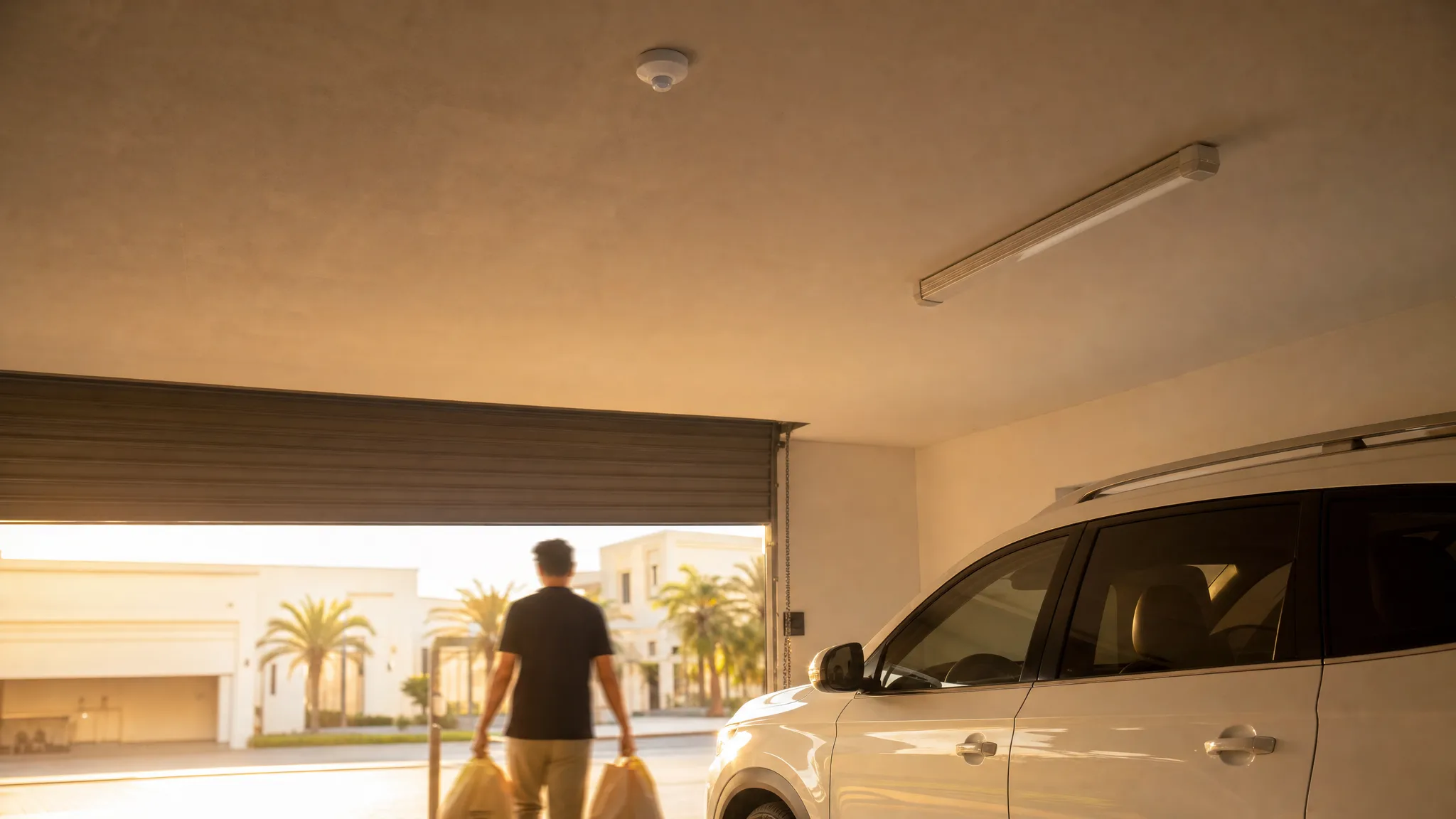
Your sensor light works all winter. Then summer arrives and you're halfway into the garage before it comes on, or it doesn't come on at all. The likely cause is the heat.
What the sensor is looking for
Almost every motion sensor sold for lights is a PIR, short for passive infrared. It picks up heat, and it reacts when a warm shape moves across its view against a background of a different temperature.
Brennenstuhl, which makes outdoor floodlights with these sensors built in, says on its support page: "At very high ambient temperatures, e.g. in summer, the distance is reduced because the difference between the ambient temperature and the temperature of the human body is only very small." (Brennenstuhl)
The same page says the range printed on the box applies "at a temperature of 20°C and without wind."
How much range you lose
The sensor chips inside these lights come with datasheets, and they put numbers on it. Panasonic's EKMB130611 lists a range of up to 7 metres when the person is 8°C warmer or cooler than the background, and up to 5 metres at 4°C. Those figures were measured in a 25°C room. (Panasonic EKMB130611 specification)
So halving the temperature gap cost that sensor more than a quarter of its reach, and the table stops at 4°C. Panasonic gives no figure for a smaller gap, and the spec sheet for a sibling sensor tells buyers to "confirm the detection characteristics under the usage environment" (Panasonic EKMC260911 specification).
In NOAA's 1974 to 1991 record for Dubai International, the average daily high was 40.6°C in July and 40.4°C in August, and the average across the whole day was 34.4°C in both months (NOAA NCEI, station 41194). A garage, a driveway or a roof terrace has no AC, so on a summer afternoon the walls and floor behind you can be about as warm as you are. That's well below the smallest gap in Panasonic's table.
Which sensors this hits
It's the ones in spaces without AC:
- the light over a villa garage or a carport
- driveway and gate lights
- outdoor stairs and side passages
- a roof terrace or a balcony
- a store room, laundry or maid's room where the AC stays off most of the day
A PIR sensor inside an air-conditioned flat sits in a room far cooler than you are, which is why the hallway light still finds you in August. If an indoor sensor is acting up, the cause is usually the opposite one, sun or AC air setting it off when the room's empty, and our motion and presence sensor guide covers that.
A quick way to check it's the heat
Rule out the simple things first, with a stable ladder and someone holding it if the sensor's up high. Switch a mains light off at the breaker before you touch it, and leave anything that means opening the fitting to an electrician. Then wipe the dust off the plastic lens, check nothing has grown or been stacked in front of it, and if it runs on batteries, change them. A sensor caked in garage dust loses range in any season.
If those are fine and it worked properly last winter, suspect the heat. A sensor that has picked up again since the weather cooled points the same way.
Try walking across it too, not straight at it. Brennenstuhl's page notes that these sensors "always detect movements across the device better than movements directly towards the product." If yours faces the door you come in through, you're walking straight at it.
What fixes it
Re-aim it so you cross its view. Many sensor heads swivel. Angle it so someone coming in walks across it rather than towards it, which costs nothing and is the fix to try first. If yours doesn't swivel and it's mains-wired, moving it to a side wall means new wiring, and that's an electrician's job.
Try a different background. The sensor compares you with whatever is behind you. If aiming it at a shaded floor instead of a sunlit door changes how far away it catches you at 3pm, keep whichever aim works better.
Turn up the sensitivity and lengthen the timer. Many lights have a sensitivity dial and a time dial on the sensor. More sensitivity helps it catch a weaker heat difference, and a longer timer means it doesn't switch off on you while you're unloading the car. Expect a few more false triggers in winter at higher sensitivity.
Use a door sensor for the garage. A contact sensor on the garage door or the side door fires when the door opens, with no body heat involved, so the light can come on before you're inside. It does need the light on a smart switch or a hub to act on it; an ordinary sensor light can't take one. Our door and window sensor guide explains how they work.
Swap to a radar presence sensor. Presence sensors send out millimetre-wave radar and read what bounces back, so they don't rely on you being warmer than the wall behind you. Before you put one in a garage or on a terrace, check the box for an outdoor or damp rating and for its temperature range, because a garage follows the weather. If it's mains-wired, that's an electrician job too.
If the light is on a smart system
A standard smart motion sensor, such as the Aqara P1 or the Philips Hue motion sensor, is a PIR inside, so it loses range in the heat the same way. But with a hub the light doesn't have to depend on it alone.
Set the garage light to come on when either the motion sensor or the door sensor fires, whichever is first. Keep it on while the motion sensor still sees you or the door is still open, so it doesn't drop out because you stood still at the boot. Limiting the rule to after sunset also stops it switching on for nothing at noon once the sensitivity's turned up.
If your sensor light gives up every summer, send us a photo of where it's mounted and we'll suggest where to start.
Ready to Get Started?
Get a free consultation and we'll recommend what makes sense for your situation.
Get Free Consultation