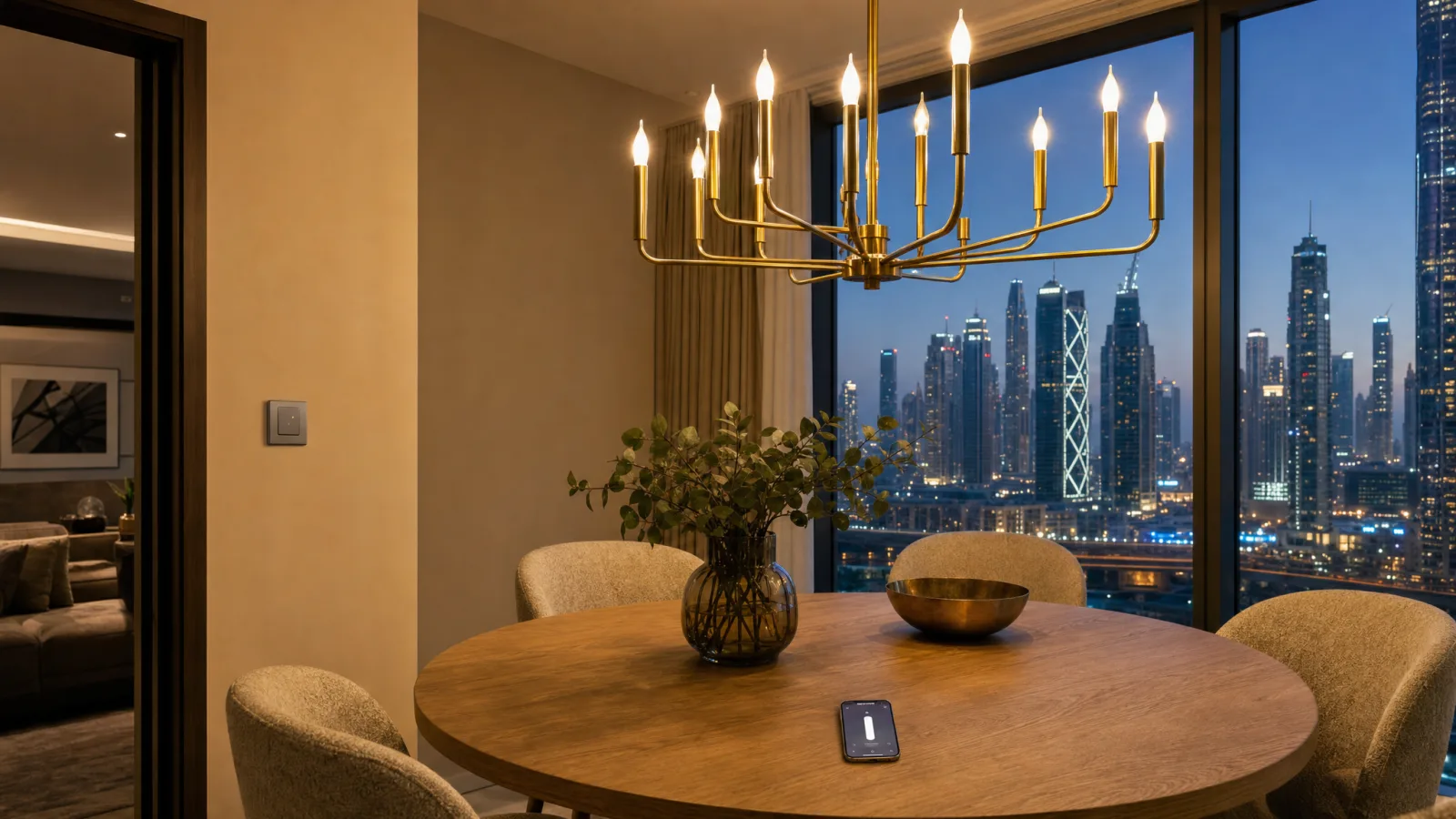
You chose the chandelier or pendant for how it looks, and now you'd like to run it from your phone, or have it come on with the rest of an evening scene. You can usually do that without replacing it. Whether it takes new bulbs or a small module behind the wall switch depends on whether the light takes bulbs you can unscrew or has its LEDs built into the fitting, and you can tell that from the floor.
With the switch off and the fitting cool, look up at it. A bulb with a screw or bayonet base can come out. A flat panel of tiny LEDs, a glowing ring or a sealed shade with no way in usually means the light is built in. If you can't tell, the product page or the box often says whether the light source can be replaced.
| What's in the fitting | Where the smart control goes |
|---|---|
| One or two bulbs you can unscrew | Smart bulbs, with the wall switch kept on |
| A dozen bulbs, as in a chandelier | Usually a module behind the wall switch |
| LEDs built into the fitting | A module behind the wall switch |
A Pendant With One or Two Bulbs
Swap the bulbs for smart ones with the same base and shape, and the fitting stays exactly as it is. You can dim it and put it in a scene from the app or by voice. With the switch off and the bulb cool, take one out (from a steady step, not a chair) and check the base printed on it before ordering, because a pendant built for a small candle bulb won't take a standard one. No wiring is involved, so this is the route that suits a rented flat, as long as the wall switch stays on.
A smart bulb only hears the app while it has power, so once someone flicks the wall switch off, neither your phone nor your voice assistant can bring it back. Philips Hue's wall switch module deals with this for Hue bulbs. It sits behind the existing switch and turns it into a button for the bulbs, which "always stay powered on and reachable" (Philips Hue).
It runs on a battery and doesn't need a neutral wire. It does need a Hue Bridge (the small hub that connects Hue lights to your home network), and it won't work with a switch that has a built-in dimmer or a combined socket and switch plate (Philips Hue in-wall guide). Fitting it means disconnecting the wires from the switch, so book an electrician for it.
A Chandelier With a Dozen Bulbs
Smart bulbs still work in a chandelier, but each one joins your system as a separate light. A standard Hue Bridge handles up to 50 lights and 12 accessories, and the Bridge Pro is rated for 150 or more (Philips Hue). A twelve-bulb chandelier uses about a quarter of a standard Bridge before any other room is set up, and that limit is shared with every other Hue light in the home.
It's often simpler to keep ordinary bulbs in the chandelier and make the circuit smart instead. A module behind the wall switch, fitted by an electrician, turns the whole fitting on and off from the app, a schedule or a voice assistant, and the switch on the wall keeps working for guests. You give up control of each bulb on its own, along with the colour settings some smart bulbs have.
If you want to dim it this way, the bulbs have to be dimmable as well. Hue's wired dimmer module, made for ordinary lights, only works with dimmable bulbs (same in-wall guide). Hue also sells an on/off version for lights that can't dim, and that one needs a neutral wire.
A Fitting With the LEDs Built In
Many modern pendants, ceiling lights and wall lights have no bulb at all. The LEDs are fixed inside and fed by a small power supply called a driver. A smart bulb isn't an option, so the control goes at the switch.
For on and off, an electrician fits a relay module, a small switch that sits behind your wall switch and turns the power to the light on and off. Shelly's 1 Gen4, for example, is made to fit behind a light switch and controls LED, incandescent and halogen lights (Shelly). It needs a neutral wire, the return path a smart switch uses to stay powered, and a lot of Dubai switch boxes don't have one. Leave that check to the electrician with the breaker off. If the box has no neutral, the options are in smart switches without a neutral wire.
To dim it, first check that the fitting is sold as dimmable. Then the dimmer has to suit the driver, because dimmers come in two main kinds and a driver may only work with one. Philips warns that even dimmable LEDs need a compatible dimmer, or you get uneven dimming or flickering (Philips Hue).
Shelly's Dimmer Gen3, for example, is the trailing-edge kind (Shelly). Which kind your driver needs, and what each symptom means, is in why LED lights flicker or won't dim. If the fitting's packaging doesn't say dimmable, plan for on and off only.
Lights Run From Two Switches
A hallway or staircase light often has a switch at each end. Hue's battery module works on these two-way setups as long as every switch on the circuit gets a module (Philips Hue in-wall guide). For a relay or a dimmer, the electrician needs to see how the two switches are wired before choosing one. We explain how to count these in how many smart switches your flat needs.
Before Anything Goes Behind the Switch
Every module in this post sits in the box behind the wall switch. The circuit has to be switched off at the breaker and the wires taken off the switch, and Philips' guide says electrical devices should only be installed by "electrically skilled people" (same in-wall guide). In a rented flat, ask the landlord before anything is wired in.
In the box itself, the electrician should check for a neutral wire and for room behind the switch plate. Light-switch boxes in Dubai walls are often shallow, so the module has to be a slim one, and we went through checking back-box depth separately.
Send us a photo of the fitting and one of the switch that runs it, and we'll tell you which route is likely and what the electrician should check.
Ready to Get Started?
Get a free consultation and we'll recommend what makes sense for your situation.
Get Free Consultation