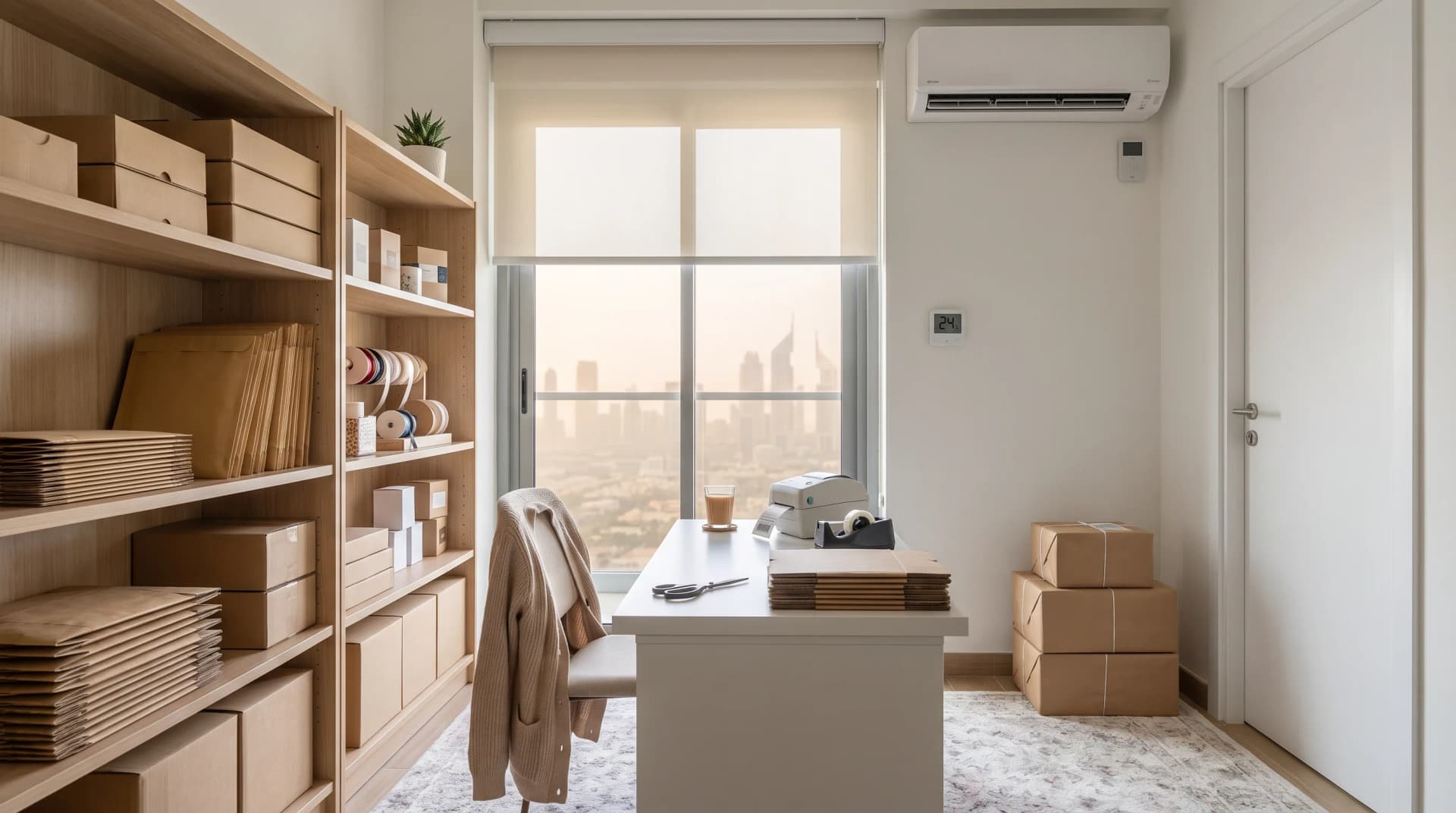
An order lands on Instagram at eleven at night. You send a payment link from your phone, it clears before you have put the phone down, and by morning you are watching a courier move across a map in real time.
Then you open the door of the second bedroom, where the business actually lives, and it has been sitting at thirty-something degrees behind a closed door since Thursday, because nobody ever decided that room was a workplace.
TL;DR: A home that runs a business has three problems a normal home does not. Stock sits in a room nobody conditions. People who are not family arrive at your door on a schedule. And the working day has no building to leave. One sensor, one managed lock, and one closing scene cover all three.
What Changes When Your Home Has a Second Job
A home business crosses three lines that a laptop on the dining table never does.
The first is inventory. The moment you hold stock, part of your home is storage, and storage has conditions. The second is footfall. Couriers collecting, a client arriving for a consultation, an assistant coming twice a week: people who are not your family now cross your threshold on a schedule you do not fully control. The third is the clock. An office is a place you leave. A home business closes when you decide it closes, which in practice means it does not.
Two things sit alongside those and are worth settling early, because neither is a smart home problem. Your building may have views about deliveries, foot traffic and noise from a residential unit, so read your tenancy terms and the building rules before you advertise collection hours or put your address on anything. Management is a much cheaper conversation to have before the complaints than after. And if strangers are coming through your door, or stock worth real money is sitting in your spare room, ask your insurer whether your current policy still covers you. Ordinary contents cover assumes a household, not a business operating out of it.
The Licence Question
Running a business from a Dubai home is a licensing matter, not a smart home matter, and no automation fixes the paperwork.
Dubai has routes built for people with no office. The eTrader licence, sometimes called DED Trader, is the one people name most often, and freelance permits and free-zone packages cover other cases.
Where the Sources Disagree
Eligibility is where this gets misread, so be careful what you take from a blog, including this one. The UAE government portal describes the eTrader licence as being for UAE nationals and GCC nationals residing in Dubai, while a number of business-setup sites tell expat residents they can hold one, and those sites also disagree with each other on the fee by hundreds of dirhams. We are not going to resolve that for you, and neither is any company selling you a licence service. Ask the Department of Economy and Tourism which route fits your nationality and your specific activity, and do it before you spend anything on the room.
You are not doing anything unusual by asking. Dubai had issued more than 18,000 eTrader licences between the scheme's launch in March 2017 and the end of March 2022, on the Department of Economy and Tourism's own licensing figures (Khaleej Times, 2022), and that count is several years stale now.
The Licence Follows Your Address
Whichever route you land on, the licence is tied to an address. Move, and that follows you, and so does everything below.
The Room Where Your Stock Lives
Dubai's summers run to an average high of 41.8 degrees with overnight lows around 29.7 (Dubai Government Media Office). A spare room with the door closed and the AC off is not holding whatever the rest of the flat is holding, and almost nobody plans for that. How far it drifts depends on your walls, your windows and which way the room faces, which is why the only number that matters is the one measured in your room.
If that room holds nothing but a desk, the cost of the drift is a warm room. If it holds product, the cost is the product. The hard part is that the damage is quiet. Nothing alarms. You open the door in October and find out.
Chocolate and Anything Cocoa-Based
Chocolate wants 55 to 65 degrees Fahrenheit, roughly 13 to 18 Celsius, at 50 to 60 percent humidity (National Confectioners Association). Callebaut gives the same range and says what goes wrong above it: the chocolate softens and loses its gloss (Callebaut). Let it melt and re-solidify and the fat rises to the surface as that white film. A closed Dubai bedroom in August is nowhere near 18 degrees, so if you sell chocolate, coated dates, or anything with cocoa butter in it, the numbers are not close.
Candles, Which Are Safer Than You Think
Golden Wax 415, a common container soy wax, lists a melt point of 121 degrees Fahrenheit, about 49 Celsius (CandleScience). A conditioned apartment does not get there, so the nuance runs in your favour. Candles can still soften and lose their shape in a humid climate even with air conditioning running (Alphawax), which makes warping a real risk while a puddle of wax on your shelf is not. Do not let anyone sell you a climate system on the strength of a melting-candle story.
Skincare, Which Is the Surprise
Store below 25 degrees, says Phyto-C, whose chief scientist formulates vitamin C serums for a living, because every degree above that pushes the molecule closer to breakdown and cuts its concentration and effectiveness (Phyto-C). That threshold is lower than most people expect, and 25 degrees is a temperature a Dubai flat holds only where somebody is choosing to hold it.
Paper, Print and Fabric Care About Humidity, Not Heat
Conservation guidance keeps paper and textiles between 30 and 60 percent relative humidity, because warm air and high humidity together are what bring on mould (NEDCC). If you hold printed packaging, stationery, art prints or fabric, your number to watch is the humidity reading rather than the temperature one, and the damage is the slowest of any category here to become visible.
Food and skincare are still the two that get caught out most, because both have documented thresholds that a room nobody was asked to condition will cross.
What the Room Needs
A temperature and humidity sensor goes in the room, not in the hallway outside it. Hallway readings are the single most common reason people believe a room is fine when it is not, and the gap between the two runs several degrees. Under AED 150 turns a guess into a number.
Then put a schedule on that room's AC that holds a ceiling rather than running a comfort setting. Nobody needs to be comfortable in there, so the room only has to stay under the limit you set, and holding a limit costs far less than cooling a room to a temperature a person would want to sit in.
Last, an alert when it crosses that line. This is the part that makes the other two worth anything, because the failure mode with stored goods is silence. An alert turns a quiet loss into a message on your phone while there is still time to move the boxes.
If Your Business Has No Stock at All
Plenty of home businesses in Dubai hold nothing physical: consulting, tutoring, design, coaching, bookkeeping. If that is you, skip the whole section above. Your room has a different job.
It is a room a client sees and hears for an hour, which makes light and sound the working parts rather than temperature. The lighting side of that is covered in full in our work-from-home scene guide, and a service business uses the same scene.
What is different is that your client work lives on devices inside your home network, next to a smart speaker your family talks to and whatever guest WiFi you handed out last Eid. Keep the two apart. Client devices and home devices on separate networks is a one-time configuration job, and we cover the reasoning in our guide to securing smart home devices.
The closing-time problem is also worse for you, not better. A stock room at least reminds you the business exists by taking up space. A consultancy is invisible, which means the only thing marking the end of your working day is the decision to stop.
The Door: Couriers, Clients and People Who Are Not Family
A home business puts strangers on a schedule at a door that was designed for a family.
Most of this is already solved ground, and we have written the full build for letting a courier in when you are not home, including one-time PINs and what the hardware costs. We will not repeat it here.
Every Code Needs an Owner and an End Date
What is different for a business is that access becomes routine and it needs to expire. A courier who collects three times a week is not the same as a one-off parcel drop. An assistant who comes Tuesdays and Thursdays needs a code that works on Tuesdays and Thursdays and stops working when they stop working for you. A client arriving for a consultation should be able to reach your door without you standing in the corridor waiting.
The rule is simple: every code should have an owner and an end date. Codes handed out casually and never revoked are how a perfectly good lock quietly becomes a bad one. A helper who lives in the home is the exception, and should hold a standing code like any other resident rather than a business code you keep renewing. A live-in arrangement is a household matter, and treating it like a delivery schedule gets it wrong. The visa and labour side of employing someone is a job for a proper adviser. Your lock has no part in it.
The Business Day Needs an Ending
An office closes because you leave the building. A home business does not close at all unless you build the ending.
The work-block side of this, the desk light, the call setup, the focus scene, is covered in our work-from-home scene guide, and a home business uses the same one. What a business adds is a closing routine, because there is more to shut down than a laptop.
A closing scene for this setup runs four things off one tap: the stock room drops to its overnight holding temperature, the packing area's task light goes off, the front-door notifications switch from business mode back to normal, and the living room comes up in an evening setting. The flat visibly changes state, and that change is what gives the part of your brain still listening for orders a signal to stop.
The honest question is whether you will override it and keep working. Some nights, yes. A closing routine you break on purpose is still better than no line at all.
What Bayora Will Talk You Out Of
A home business makes it easy to justify spending you would never approve for the flat you live in.
Cameras Pointed at Your Own Family
Skip them. A camera covering the front door or the stock room is defensible. A camera in a living room, justified as business security, is a camera in your living room. It is an easy one to talk yourself into and an easy one to regret a month later.
A System Bigger Than the Business
A business that occupies one shelf does not need whole-home automation. If it is a corner of a bedroom and a stack of boxes, the correct spend is a sensor, a controller and a lock, and nothing else. We would rather sell you AED 2,000 of the right thing than AED 15,000 of a system built for a problem you do not have.
Anything Only You Can Operate
Skip any setup that makes you the single point of failure in your own home. If it needs you personally to let a courier in or to find the right app screen, it has added a job rather than removed one.
And be clear about what a smart home cannot do. It cannot make an unlicensed business licensed, or a residential building a commercial one, or a bedroom a shop. Those conversations belong to your landlord, your building management and the Department of Economy and Tourism.
What This Costs in Dubai
The Stock Room
A temperature and humidity sensor, a smart AC controller on that room's unit, and alerting configured typically runs AED 900 to 1,600 installed. That is the whole climate side of the problem for one room, and it is the piece we would do first.
The Door
Door access costs more for a business than for a household, and the reason is the codes. A retrofit lock and a video doorbell on their own land around AED 1,900, but per-person codes you can issue and revoke remotely need the hub, which puts the build at AED 2,400 to 2,900 on the same numbers we quote in our smart lock guide. Those figures hold across most apartment doors, in Abu Dhabi and Sharjah as well as Dubai, and an older door or an unusual cylinder moves the number more than the emirate does. If you already have a lock you like, the code management is often a configuration job rather than new hardware.
If You Hold No Stock, and What It Comes To Together
If you hold no stock, ignore both of those. A service business needs the network separation, which is configuration rather than hardware, and a closing scene, which means a wall keypad and the lighting it drives at AED 400 to 1,000 depending on how many rooms it touches. That is the whole bill for a consultancy, and it is the smallest job in this post.
Put all three together, stock room and door and closing scene, and you are at AED 3,700 to 5,500. Our Smart Home Starter begins at AED 3,000, and what separates the two is where the money points. A normal home spends that on comfort in the rooms people sit in. A home business spends it on climate control for stock, code management for a door, and a routine that draws a line under the day.
Frequently Asked Questions
Can I legally run a business from my apartment in Dubai?
With the right licence, yes. Dubai has licence routes designed for people working without an office, including the e-Trader licence for online selling and freelance permits for service work. Confirm the details and current fees with the Department of Economy and Tourism, and check your tenancy contract separately, since your landlord's terms are a different question from your licence.
How hot does a closed spare room get in a Dubai apartment in summer?
Hotter than the rest of the flat, and the only honest answer for your room is a measured one. A shut room with no air moving through it runs several degrees warmer, and how many depends on your walls, windows and which way it faces. Put an AED 150 sensor in there for a week before deciding.
Do I need a separate AC schedule for a stock room?
If you store anything temperature-sensitive, yes, and it should be a ceiling rather than a setpoint. Run it as a limit the room never crosses, on a schedule that ignores whether anyone is home, and pair it with a threshold alert. The alert is what turns a thermostat into a warning system, and without one you are only logging numbers.
How do I give a courier or assistant access without giving them a key?
Use a smart lock with time-limited codes. Each person gets their own code, valid only on the days they need it, and you can revoke any of them from your phone without changing a lock. Our smart lock guide covers the hardware and what it costs for a Dubai apartment door.
Does a home business need different home insurance in Dubai?
Probably, and it is worth a phone call. Standard home contents cover is written for households, so business stock stored at home and visitors coming for business reasons can both sit outside it. Ask your insurer directly what your policy does and does not cover before you assume either way.
A home that runs a business is still a home. It has one room doing work nobody assigned it, a door with a schedule, and a day that needs a finish line. Handle those three and the rest of the flat can go back to being where you live.
Tell us what you are running from home and we will tell you which of the three applies to you, and what it costs, before you commit to anything.
Ready to Get Started?
Get a free consultation and we'll recommend what makes sense for your situation.
Get Free Consultation