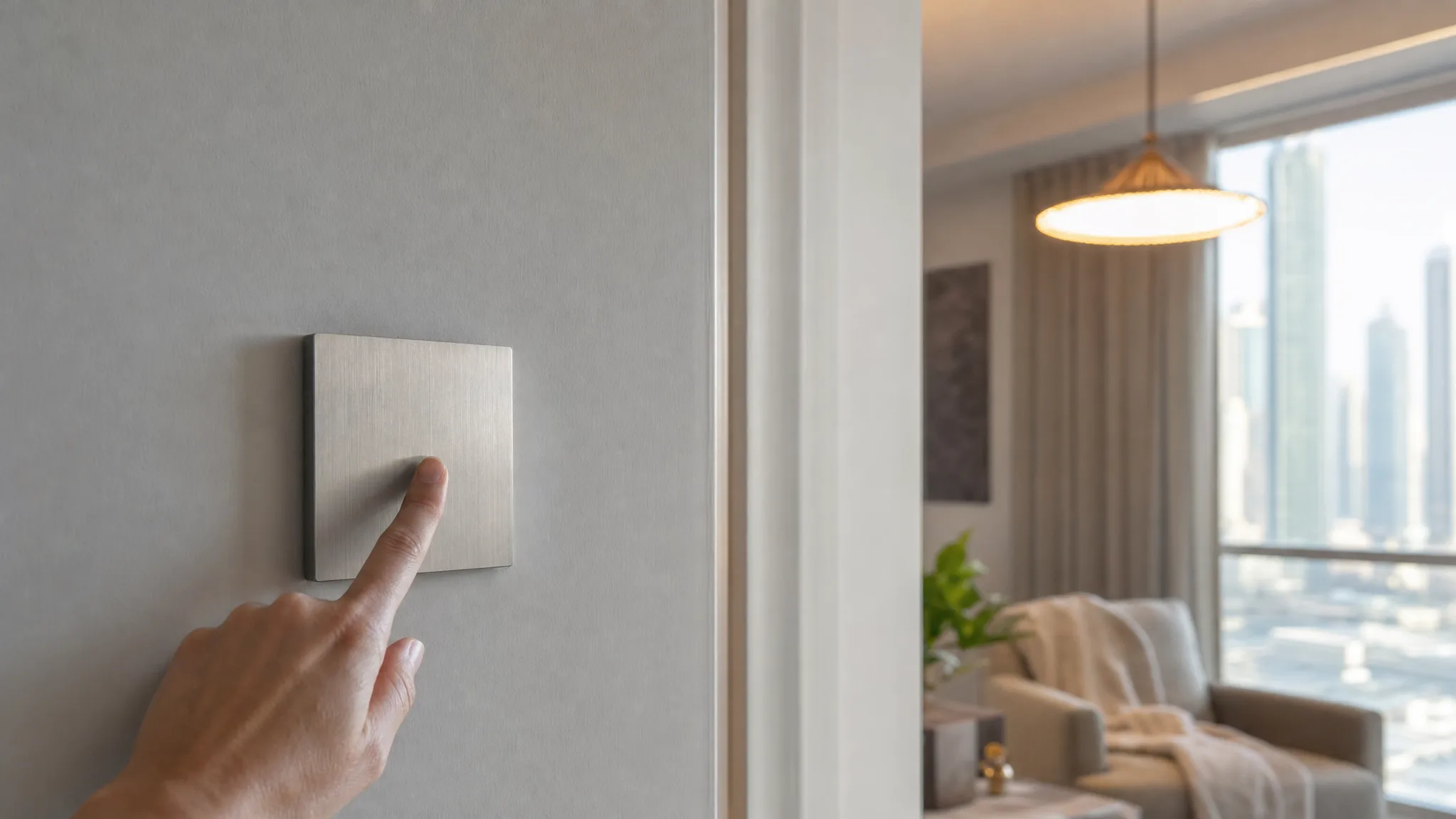
A battery-free light switch, sometimes sold as a kinetic switch, has no battery inside and no cable running to it. When you press it, the press itself makes a tiny amount of electricity, and the switch spends all of it sending one short radio message. In a Dubai flat, whether that message arrives depends on where its receiver sits and how much concrete is in the way.
Someone asked us to quote for these this month, and we went through the manufacturers' documents to answer it. We haven't fitted one in a client's home yet, so what follows comes from those documents and from what we know about Dubai walls, not from our own installs.
How a switch with no battery sends anything
EnOcean makes one of these energy-harvesting modules and sells it to switch brands. Its datasheet for the PTM 215ZE explains that pushing down the bow, the part the rocker presses, generates the electricity and sends a 2.4 GHz radio message (EnOcean PTM 215ZE datasheet, May 2023).
The bow travels 1.8 mm and takes about 10 newtons to push. The same sheet calls the module "self-powered (no batteries) and fully maintenance-free" and rates it at about 100,000 presses at 25°C, with an operating range of -25°C to 65°C. A cooled Dubai living room sits comfortably inside that.
The module only has power for the instant of the press, so a switch built on it sends its message and moves on. Don't expect a status light on the switch, or any sign there that the light got the message.
The switch doesn't switch the light
A normal wall switch breaks the live wire to the light. A battery-free switch touches no wire at all. It sends a message, and something else has to receive it and do the switching.
There are two ways that something gets there.
The first is a receiver relay fitted near the light. It's a small mains-powered box that listens for your switch and turns the circuit on and off. One European example, Eltako's FSR61NP, is 33 mm deep and draws 0.8 watts even while it waits (Eltako lists it in its main catalogue, page 3-14). Thirty-three millimetres is deeper than the 16 to 25 mm boxes many Dubai light switches sit in, which we covered in why most smart switches don't fit UAE walls. So the receiver may have to live somewhere else: above the false ceiling near the light, or in a deeper box an electrician fits for it.
The second is a smart lighting system you already own. Niko makes a kinetic switch for Philips Hue that talks to the Hue Bridge over Zigbee, the radio Hue uses (Niko). Here the bulbs stay powered all the time and the switch tells the bridge what to do with them, the same arrangement we described in smart bulbs vs smart switches. If the bridge is unplugged, the switch has nobody to talk to.
Either way, something in the system is always on. The switch needs no power of its own, but the receiver, or the bridge and the bulbs, need it around the clock.
How far the signal gets through Dubai walls
EnOcean's datasheet gives the PTM 215ZE a range of "typ. 175 m free field / 20 m indoor". Twenty metres sounds like plenty for an apartment. The user manual is more careful. Its rough guide for walls, for this 2.4 GHz module:
- Plasterboard walls or dry wood: "Typically 15 m range, through max. 2 walls"
- Ferro concrete walls and ceilings: "Maximum 1 wall or ceiling, depending on thickness and material"
- Fire-safety walls, lift shafts and staircases: treat them "as shielded"
That's from the PTM 215ZE user manual (v2.5, March 2024), section 6.1. The same section says mounting the switch on a metal surface can cost "up to 30% loss of transmission range", and it lists metal false-ceiling panels, metal-coated glass and steel furniture among the things that get in the way.
In a Dubai tower flat, the floor slab and the core walls are reinforced concrete, and that's where the one-wall figure applies. Interior partitions are often concrete block or gypsum on a steel frame (we went through all four wall types in what's behind a Dubai apartment wall). The manual gives no figure for block, and gypsum on steel isn't quite its plasterboard case either, so for most partitions there's no number to plan with. A switch by the bed may have a block partition between it and the receiver, the concrete core, or both.
A receiver in the ceiling just above the switch has a short, clear path. A receiver in the distribution board, which can be two or three rooms away, has to reach through every wall in between, and if the board is a metal box, out of that too.
EnOcean's manual says "range tests should always be performed", and it doesn't cover distribution boards at all. On a job like this we'd want the receiver in place and each switch pressed from its intended spot before anyone closes a ceiling.
Check the radio before you buy two halves
Battery-free switches don't all speak the same radio. EnOcean sells its classic switch module in three regional versions, 868 MHz for Europe, 902 MHz for North America and 928 MHz for Japan, plus 2.4 GHz Zigbee versions it labels "worldwide" (EnOcean). The Eltako receiver above is an 868 MHz part (EnOcean Alliance).
The switch and whatever receives it have to be on the same one. A switch ordered from one shop and a receiver from another can each be fine and never hear each other. The Hue route sidesteps most of this, since Niko's switch talks Zigbee, the same radio as the bridge. For a standalone receiver, ask the seller which frequency both parts are, and get it in writing.
Where a battery-free switch makes sense
The obvious place for one is a wall where you want a switch and there's no cable: the bedside wall nobody wired, a glass partition, a marble wall you won't chase, a second switch at the far end of a long room.
It's a weaker choice when the receiver would sit a long way off through concrete, or when you want the switch itself to show you whether the light is on.
If a battery-free switch is replacing a wired one on the wall, the live and switched wires behind it still have to be dealt with, usually joined through so the receiver or the bulb gets a permanent feed. That's mains work, done with the circuit isolated at the board, and it's a job for a licensed electrician. The same goes for fitting the receiver itself.
What to ask before you order
- Where will the receiver sit (at the light, in the ceiling, or in the distribution board), and how many walls or slabs are between it and each switch?
- Are the switch and the receiver on the same frequency, and is that written on both boxes?
- If it's a Hue switch, is your bridge a model the switch maker lists (Niko names the Hue Bridge V2), and is it close enough to reach the switch?
- If you're replacing engraved keypads, can the new rockers be engraved too?
- Will someone press every switch from its real position before the ceiling goes back?
If the answer to the first is "the distribution board, several rooms away", a wired smart relay behind the existing switch may serve you better, and our post on smart switches with no neutral covers what that needs.
Thinking about a switch on a wall that has no wire to it? Send us a photo and a rough floor plan and we'll tell you where the receiver would have to go.
Ready to Get Started?
Get a free consultation and we'll recommend what makes sense for your situation.
Get Free Consultation