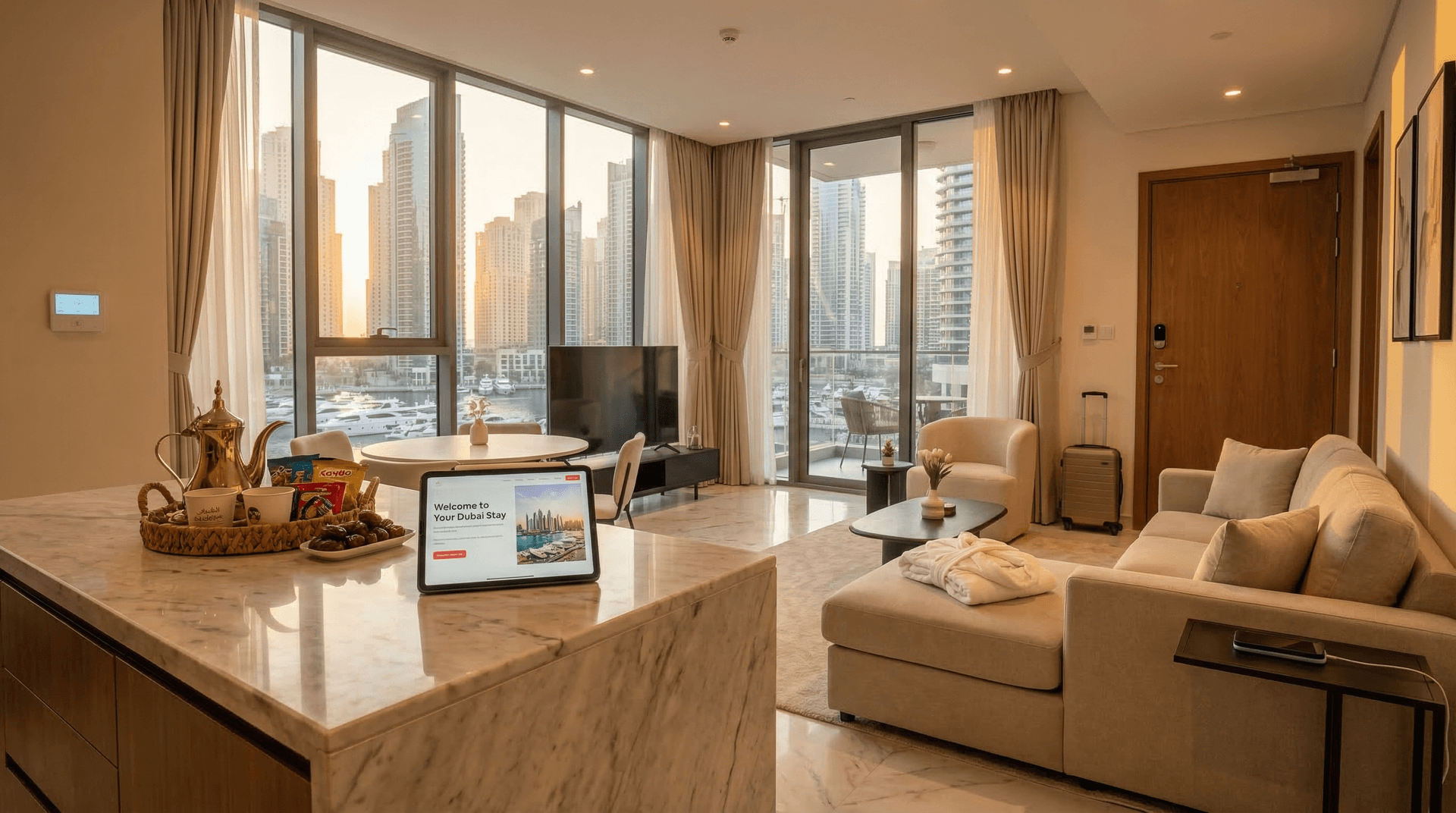
Dubai welcomed 19.59 million visitors in 2025, a new record (Gulf News, 2026). A growing chunk of those travelers skipped hotels and booked furnished apartments through Airbnb and similar platforms. With roughly 57,000 active short-term rental listings in the city (AirROI, 2026), the competition for guests is fierce. The hosts pulling ahead? They're the ones treating technology as part of the guest experience, not an afterthought.
TL;DR: Dubai's best-performing Airbnb hosts install smart locks for keyless check-in, smart AC controllers to keep DEWA bills down, and automated lighting to make guests feel at home. These upgrades improve reviews, reduce operating costs by 15-25%, and help properties stand out in a market with 57,000+ competing listings. Most setups pay for themselves within one season.
Why Are Dubai Hosts Adding Smart Home Tech Now?
The short answer: survival. The Dubai short-term rental market matured fast. Average occupancy sits around 44% for a typical listing, but top-performing properties hit 87% or higher (AirROI, 2026). The gap between average and excellent is enormous, and the difference often comes down to guest experience details.
DTCM regulations already push hosts toward higher standards. Every licensed holiday home needs safety equipment, proper furnishing, and a keyless lock for guest access (Dubai DET, 2025). Hosts who go beyond the minimum with proper automation are the ones collecting five-star reviews and repeat bookings.
What Smart Home Tech Are the Top Hosts Installing?
The most common setup we see among high-performing Dubai Airbnb properties follows a clear pattern. Hosts aren't installing everything at once. They start with the tech that solves the biggest operational headaches and has the most guest-facing impact.
Smart Locks and Keyless Entry
This is where nearly every host starts, and for good reason. A smart lock eliminates the most stressful moment of any Airbnb stay: the check-in. No more coordinating key handoffs with a building security guard at 2 AM. No more lockbox codes that don't work. The guest gets a unique code before arrival, it activates at check-in time, and it expires after checkout.
In our experience, the check-in process generates more negative reviews than almost any other part of a short-term rental stay. A Yale or similar smart lock with auto-generated codes removes that friction entirely. For hosts managing multiple properties, this alone saves hours every week.
Smart AC and Climate Control
Dubai's AC bills are the silent profit killer for short-term rental operators. A two-bedroom apartment can easily run AED 800-1,500 per month in DEWA charges during summer, and most of that cost comes from cooling an empty unit between guests.
Smart AC controllers let hosts set the temperature remotely before a guest arrives, then automatically adjust or turn off when the property is vacant. Smart thermostats can cut cooling costs by 15-25% through scheduling and occupancy detection (Energy Star, 2025). For a host running three or four properties, that adds up to thousands of dirhams saved per year. Read more about how smart AC control works and what it costs.
Automated Lighting Scenes
Good hosts create a "welcome scene" that turns on when the guest enters. Warm lighting in the living room, a soft glow in the hallway, everything else off. It sounds like a small detail, but it completely changes the first impression. Guests walk into a space that feels prepared for them, not a dark apartment where they fumble for switches.
Automated lighting also handles the practical side. Lights turn off in empty rooms, exterior lights come on at sunset, and the property never looks dark from the outside (which matters for ground-floor units in villa communities like Arabian Ranches or Dubai Hills). Check out our smart lighting options to see what fits different property types.
How Does Smart Home Tech Affect Guest Reviews?
Over four out of five Airbnb reviews globally are five stars (Airbnb, 2025). That sounds great until you realize that anything below 4.8 starts hurting your search ranking. Properties with smart amenities tend to earn higher check-in scores, better location-value perception, and more mentions of "easy" and "convenient" in written reviews.
When we installed smart locks and climate control in a Business Bay apartment used for short-term rentals, the host told us their check-in rating went from 4.6 to a consistent 4.9 within two months. The guest comments shifted from logistics complaints to comments about the apartment itself. That's the goal: remove the friction so guests talk about the experience.
What Does a Basic Airbnb Smart Home Setup Cost?
A functional smart home setup for a one-bedroom Airbnb in Dubai starts from around AED 5,000-8,000 installed. That typically includes a smart lock, smart AC control for the main living area and bedroom, and basic lighting automation. For a two-bedroom property, expect AED 8,000-15,000 depending on the number of AC units and the level of lighting control.
Properties with smart home features command 5-15% higher nightly rates and experience 30% shorter vacancy periods compared to similar listings without automation (Rently, 2025). At an average nightly rate of AED 950 in Dubai, even a 5% increase pays for the entire setup within a few months of bookings.
What we've found is that most hosts break even on their smart home investment within a single high season. The ongoing savings on DEWA bills and the time saved on guest management are pure profit after that.
Can Hosts in Rented Properties Install Smart Home Tech?
Yes. Most of the tech that works for Airbnb hosts is wireless and portable. Smart AC controllers plug in and communicate with existing split units via infrared. Smart bulbs screw into standard fixtures. Even smart locks can be installed without modifying the door, and the original lock hardware goes back when you move out.
If you're operating a holiday home in a rental property, you're already navigating DTCM permit requirements and building management approvals. Smart home devices don't require additional permissions in most buildings. We've set up properties in Dubai Marina, JBR, Downtown, and Palm Jumeirah without any building management issues.
For a deeper look at what's possible in rental apartments, read our complete guide to smart home tech for Dubai renters.
What About Security and Noise Monitoring?
Security cameras in common areas and smart doorbells are popular with hosts who manage properties remotely. A camera at the entrance lets you verify guest check-ins without being on site. Smart doorbells with two-way audio let you communicate with delivery drivers or maintenance staff.
Noise monitoring devices are gaining traction too. They don't record conversations. They measure decibel levels and send alerts if noise exceeds a threshold you set. For hosts worried about parties or neighbor complaints, this is a practical solution that protects the property without invading guest privacy. Learn more about smart security options for Dubai properties.
How Does Smart Home Tech Help With DTCM Compliance?
Smart home technology makes DTCM compliance easier, and most hosts don't think about this angle. The Dubai Department of Economy and Tourism requires holiday home operators to maintain safety standards, provide secure access, and keep properties in good condition (Dubai DET, 2025).
Smart smoke detectors send real-time alerts to your phone. Smart locks create an access log showing exactly when guests checked in and out. Temperature monitoring prevents AC-related issues like mold (a real problem in Dubai's humidity). These aren't features for guests. They're operational tools that make running a licensed holiday home smoother.
Frequently Asked Questions
Do I need WiFi in the property for smart home devices to work?
Yes, a stable WiFi connection is required for initial setup and remote control. Most devices continue running schedules locally if the internet drops temporarily, but remote access and notifications need WiFi. We recommend a dedicated router for smart home devices, separate from the guest network.
Will smart home tech work with any AC brand in Dubai?
Smart AC controllers work with any split unit that has an infrared remote control, regardless of brand or age. They learn the remote signals from your existing AC and replicate them. This covers the vast majority of residential AC units installed in Dubai apartments and villas.
How long does installation take for an Airbnb property?
A basic smart home setup for a one-bedroom Airbnb property takes about half a day. A two-bedroom with full lighting, AC control, and a smart lock can be completed in a single day. We configure everything, test all automations, and create a simple guest guide before we leave.
Do guests need to download any apps to use the smart home features?
No. The best Airbnb smart home setups require zero apps from guests. Smart locks use PIN codes. Lighting scenes activate automatically or through simple wall switches. AC runs on schedules. If guests want voice control, they can use an in-room speaker with Alexa or Google Home, but it should never be required.
What happens if a guest breaks a smart home device?
Smart home devices for short-term rentals are designed to handle frequent use. Smart locks and AC controllers rarely have issues. If something does break, most problems can be diagnosed and fixed remotely. We include 12 months of support with every installation, and replacement parts are usually available same-day in Dubai.
Ready to set up your Airbnb property with smart home tech? Get a free consultation and we'll recommend exactly what your property needs based on its size, location, and how you manage it. No obligation, no surprises.
Ready to Get Started?
Get a free consultation and we'll recommend what makes sense for your situation.
Get Free Consultation