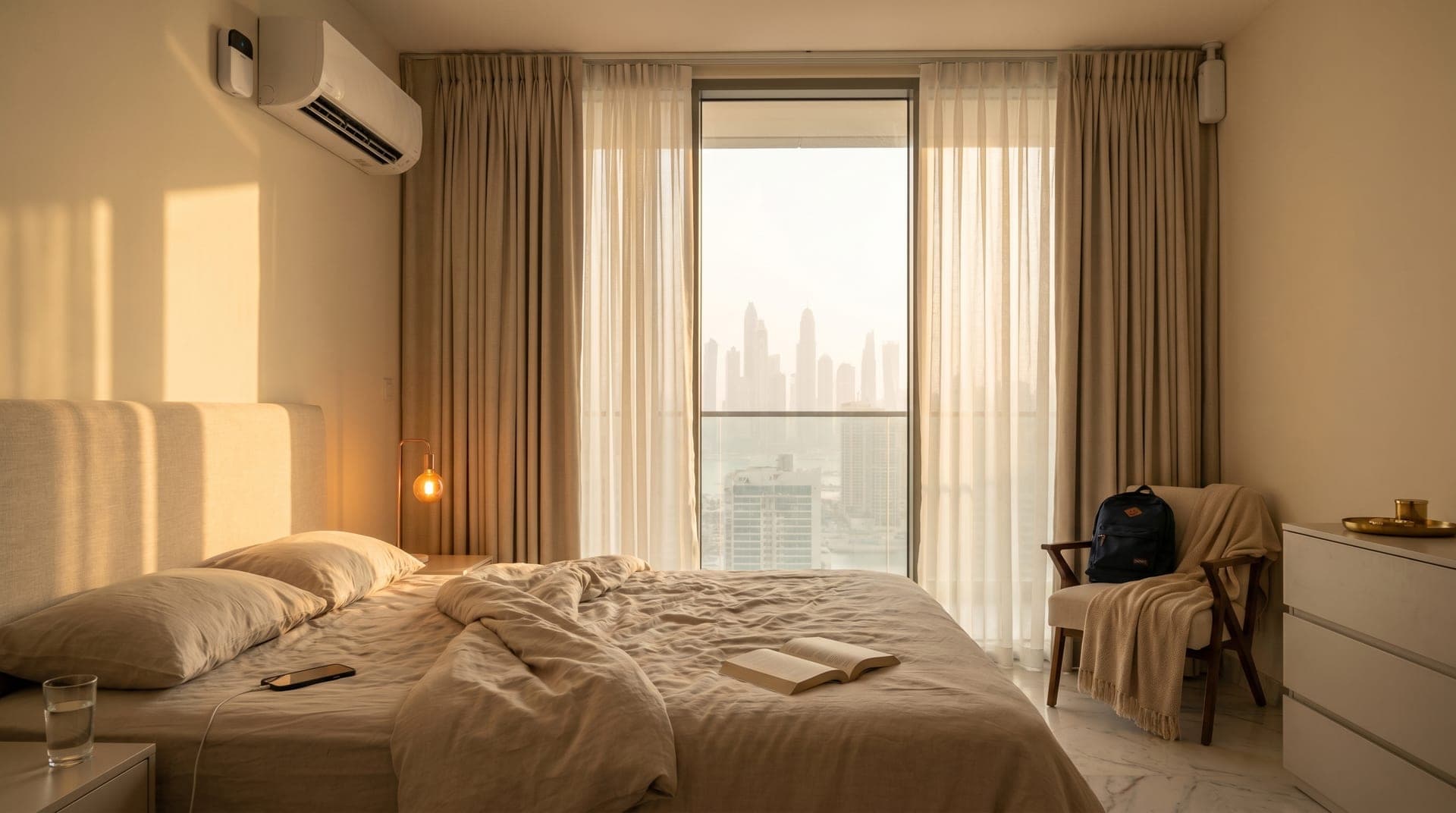
Schools are back in person Monday. The week of distance learning is over. Working parents across Dubai are looking at the next morning and remembering what 6:30am feels like once the school run is back on the calendar.
Most apartments are not set up for this. Your phone alarm goes off. The bedroom is cold or the bedroom is hot, depending on which way you got it wrong the night before. The blinds are still shut because they always are. The coffee machine is in the kitchen, off. The kids' room is dark. You walk through twenty manual steps that the apartment could have done while you were brushing your teeth.
Renters get told this is the price of not owning the place. It is not. None of the fixes below need a drill. None need landlord approval. The whole setup costs less than a single month's rent in most Dubai apartments and it lives in your suitcase when your lease ends.
TL;DR: A six-device morning routine for Dubai renters: smart AC controller pre-cools at 6:00am, motorized curtains open with the sunrise, a wake-up bulb in the bedroom ramps from warm-dim to cool-bright over 20 minutes, smart plugs start the coffee and the kids' room lamp, and a single tap on your phone (or a voice command) ties them together. Total cost AED 2,200-3,200. No drilling, no permission slips. Sets up in one evening.
This is the morning version of the 3-scene lighting routine for renters we wrote about earlier this year. That post covered the evening. This one covers what happens before you are awake enough to think.
Why Your Morning Is the Hardest Part of the Day to Fix
Sleep researchers call the first 20-40 minutes after waking "sleep inertia." It is a real, measurable state of reduced alertness, slower reaction times, and impaired working memory (NSS Dovepress, 2019). Cognitive performance does not return to baseline for 1-2 hours after a normal alarm-clock wake-up (PubMed, 1999). Working memory in particular takes a hit, which is why you spend the first half-hour of the day forgetting where you put your keys.
In our experience, the apartments that handle this well share one thing: the home does the easy stuff so the people don't have to. Pre-cool the bedroom. Open the curtains slowly. Light the bedroom in cool-bright tones. Start the coffee. Light the kids' room. None of these tasks require thought from a half-asleep adult, but every one of them currently does.
A 2024 study on multimodal bedroom alarms (light + sound + temperature) found measurable improvement in subjective alertness compared to a single-channel buzz alarm (PubMed Central, 2024). The smart home version of "multimodal" is what we are building below: light, climate, and the coffee machine, all firing on a schedule, before the alarm even goes off.
The Dubai Morning Problem, Stated Honestly
Dubai mornings have three things working against the renter that mainland-friend morning-routine articles do not address.
First, the heat builds overnight in concrete and marble. By 5am in May the bedroom is already at 27-28C, and a cold AC blast at 6:30am is not the same as a bedroom that has been at 22C for thirty minutes. Pre-cooling matters more here than in almost any other climate.
Second, the schools start early. UAE public schools split into a 7:15am group and an 8am group (Gulf News, 2025). Many private schools land between 7:30am and 8:15am drop-off. That means the parent's wake-up moves to 5:30-6:30am, and the kids' wake-up to 6:00-6:45am. There is no slack in the window.
Third, the apartment is rented. Drilling is off the table. Hardwiring switches behind the wall is off the table. Your landlord did not put a smart thermostat in the bedroom and is not going to. Everything has to clip on, plug in, or sit on a shelf.
The setup below is built around those three facts.
Device 1: A Smart AC Controller for the Bedroom (Pre-Cool Before Wake-Up)
This is the highest-impact device in the entire routine. A smart AC controller learns your AC's infrared remote codes and turns the unit on and off from a schedule, an app, or a voice command. It clips to a wall or sits on a shelf, line-of-sight to the AC. No wiring, no installation, no landlord conversation.
The Sensibo Sky is the standard pick in Dubai, around AED 600-700 on Noon UAE and Amazon.ae (Noon UAE, 2026). Set it to switch the bedroom AC on at 6:00am to 22C. By the time the alarm goes off at 6:30am, the room is already where you want it. The AC does not have to fight a hot bedroom for the first ten minutes you are awake.
What we have found: pre-cooling 30 minutes before wake also cuts the early-morning AC load by 15-30% compared to switching it on full-blast at 6:30am. The compressor does not have to overshoot. The whole apartment runs cooler on less work. We covered the physics in the AC pre-cooling schedule guide.
One controller per AC unit. A 1-bedroom needs one (just the bedroom). A 2-bedroom with kids needs two: bedroom and kids' room. The kids' room AC fires at 6:15am instead of 6:00am, so you don't have to listen to it run for an extra fifteen minutes.
Device 2: A Motorized Curtain Opener (Sunrise Without Pulling a Cord)
Dubai sunrise lands at 5:35am in May. By 6:00am your apartment has 25 minutes of natural light hitting the curtains it cannot get through. A motorized curtain opener fixes this without touching the curtain rod that came with the apartment.
The SwitchBot Curtain Rod 3 clips onto an existing curtain rod in about 30 seconds (Microless UAE, 2026). The motor pulls the curtain along the existing rod on a schedule. Total kit (Curtain Rod 3 + small solar panel + SwitchBot Hub Mini for WiFi/voice) lands around AED 350-450 per window.
Set the bedroom curtain to open at 6:15am, slowly, over about 60 seconds. The room fills with natural Dubai sunrise light fifteen minutes before your alarm. This is the part of the routine that gradually pulls you out of deep sleep instead of jolting you. Philips Hue's wellbeing research, and the broader sleep-medicine literature, both support gentle light exposure 20-30 minutes before wake as the most effective non-pharmacological intervention for reducing sleep inertia (Philips Hue, 2025).
The 2000mAh battery on the SwitchBot Curtain lasts about 8-12 months on one charge, longer with the solar panel attached. When you move, you peel it off the rod and put it in your suitcase.
What we tell clients on a budget: skip the motorized curtain in rooms where the light does not reach the bed, or where the apartment faces a building rather than open sky. Dubai Marina towers facing each other often need the bulb-based wake-up below instead.
Device 3: A Wake-Up Bulb in the Bedroom Lamp
A wake-up bulb sits inside the bedside lamp you already own. It ramps from off to a warm-dim glow to a cool-bright tone over 20-30 minutes. This is the single most effective bulb-based intervention for grogginess, and unlike the curtain it works in any room, with any window orientation.
The Philips Hue White Ambiance E27 (around AED 149 on Sharaf DG and Noon) is the reliable pick. Pair it with a Hue Bridge if you have other Hue bulbs in the apartment, or run it on Bluetooth-only for a single-bulb setup. The Wake Up automation in the Hue app handles the schedule. The IKEA Tradfri and LIFX equivalents work similarly.
The schedule we recommend for a 6:30am alarm: bulb starts ramping at 6:10am at 2200K and 1% brightness, hits 4000K and 50% by 6:25am, and lands at 4500K and 80% at the alarm. The colour temperature shift from warm to cool matters as much as the brightness ramp. Cool-bright light suppresses melatonin and signals the body to wake; warm-dim light does not (Philips Hue Wellbeing, 2025).
The same bulb runs the evening Wind Down scene at 2200K and 10%, which earns the spend on its own. One bulb, two routines. If you have a partner who wakes at a different time, put the wake-up bulb on the side of the bed of whoever wakes earlier and use the bedroom ceiling light for the household-level routine.
Device 4: A Smart Plug on the Coffee Machine
This is the least glamorous device in the routine and the one that gets the most use.
A smart plug sits between your coffee machine and the wall socket. The coffee machine has its own power switch left in the on position. The smart plug controls the actual current. At 6:25am, the plug switches on. The coffee machine boots, heats up, and is ready to brew the moment you walk into the kitchen.
The catch: this only works for coffee machines that wake straight to brew-ready when power is restored. Most drip machines, capsule machines (Nespresso, Dolce Gusto), and bean-to-cup machines with a physical power button left depressed will. Espresso machines with a software power button often will not.
A second smart plug in the kids' room runs the bedside lamp from a regular non-smart bulb, set to switch on at 6:30am to a low-glow kids' lamp the kids already own. Same idea, smaller cost. Generic smart plugs in the UAE land at AED 60-80 each, Aqara and Shelly versions at AED 100-150 (Aqara on Amazon.ae, 2026).
Two smart plugs in the morning routine: AED 120-160. They do more work than any other device for the price.
Device 5: A Hub or Smart Speaker That Ties It Together
Without a hub, every device runs on its own schedule and you have four separate apps to manage. With a hub, the whole routine fires from one trigger: a single phone tap, a single voice command, or a time-of-day automation that fires every weekday and skips the weekend.
There are three sensible hub paths for a Dubai renter:
The SwitchBot Hub Mini (AED 105-180) is the cheapest functional option. Connects the SwitchBot Curtain to WiFi and adds Alexa, Google Home, and Apple HomeKit support. Light on features but enough to run the morning routine.
The Apple HomePod Mini (AED 449-499 at Sharaf DG) doubles as a bedroom alarm clock and a HomeKit hub. It can run the entire routine on a HomeKit automation, and the morning alarm itself can be a Siri-triggered wake-up scene that fires the AC, curtain, and bulb at the same time. This is the setup we install most often for clients who already use iPhone.
A Google Home or Amazon Echo speaker (AED 200-400 depending on model) does the same job for Android households. Routines in the Google Home app and Alexa app handle the orchestration.
In our experience, the family that uses voice control on the morning routine ("Hey Siri, good morning" or "Alexa, start my morning") gets more use out of the system than the family that depends on a phone tap. The voice command works when one hand is holding a toothbrush and the other is fishing for a sock. The phone tap requires you to be conscious enough to find the phone.
Device 6: A Single Motion Sensor in the Hallway
This is optional and the smallest device on the list, but it changes how the routine feels.
An Aqara Motion Sensor P1 (AED 80-150 on Amazon.ae) sits on a shelf in the hallway between the bedrooms and the kitchen. When motion is detected between 5:45am and 7:30am on a weekday, the hallway lamp comes on at 30% warm-dim. When motion stops for 90 seconds, it goes off.
The sensor solves the small problem of walking from a bright bedroom to a dark kitchen at 6:35am with a sleepy toddler behind you. It also handles the spouse who wakes 20 minutes later, or the early-rising kid who wanders out before the official routine fires. The hallway is lit when there is a person in it, dark when there isn't.
The same sensor can run a separate evening rule: motion in the hallway after 11pm triggers the same lamp at 5% warm-dim, so the late bathroom run does not require a flicked overhead. One AED 100 device, two scenes, both running for years on a CR2450 battery that lasts about 3-5 years.
Putting It Together: The 30-Minute Morning Choreography
Here is what the apartment does between 6:00am and 6:30am once the routine is running, assuming a 6:30am alarm and a 7:30am school drop-off.
| Time | Device | Action |
|---|---|---|
| 6:00am | Bedroom AC controller | Bedroom AC on, set to 22C |
| 6:10am | Bedroom wake-up bulb | Bulb starts ramping from 2200K/1% |
| 6:15am | Bedroom curtain motor | Curtain opens slowly over 60s |
| 6:15am | Kids' room AC controller | Kids' AC on, set to 23C |
| 6:25am | Coffee machine smart plug | Plug switches on, coffee preheats |
| 6:25am | Kids' room lamp smart plug | Lamp on at low warm-dim |
| 6:30am | Wake-up bulb finishes ramp | At 4500K/80%, bedroom is fully lit |
| 6:35am | Hallway motion sensor | Hallway lamp on at 30% as you walk through |
Total cost for the full setup, with one of each device and a hub, lands between AED 2,200 and AED 3,200 depending on which speaker you pick and how many AC controllers you need. A single-AC studio runs around AED 1,800. A 3-bedroom family apartment with kids' rooms and a guest bedroom runs closer to AED 4,000.
| Setup | Devices | Cost |
|---|---|---|
| Studio / 1BR | 1 AC controller, 1 curtain, 1 wake-up bulb, 2 plugs, 1 hub | AED 1,800-2,400 |
| 2BR with kids | 2 AC controllers, 1 curtain, 1 wake-up bulb, 2 plugs, 1 hub, 1 motion sensor | AED 2,200-3,200 |
| 3BR family | 3 AC controllers, 2 curtains, 2 wake-up bulbs, 3 plugs, 1 hub, 2 motion sensors | AED 3,500-4,500 |
The whole thing sets up in one evening if you order the parts the night before and pick a slow Sunday. The apps walk you through the device pairing. The schedules take maybe twenty minutes once everything is on the network.
What to Skip in the First Round
Bayora's third principle is to recommend what fits, not what is most expensive. So three things we do not recommend buying for the morning routine on the first pass.
A full motorized blind system. The curtain rod opener does the same job for one-tenth of the cost. Motorized blinds make sense when you own the property or when the building has unusual window shapes. They do not make sense as the first device.
A whole-apartment smart speaker network. One hub is enough. Two is fine for a 3BR. Six in a 1BR is just lights with extra steps.
A smart fridge, smart oven, or smart kettle. None of these meaningfully improve the morning. A kettle should not go on a smart plug at all, because it pulls as hard as a water heater (here is why). A smart plug on a drip coffee machine, its own switch left on, has it hot and ready for about AED 80. The fridge does not need to talk to anyone before 7am.
We cover the broader renter-friendly device shortlist in Smart Home Devices for Dubai Renters You Can Take When You Move, and the evening counterpart routine in The 3-Scene Lighting Routine. Together those three posts cover most of what a Dubai renter needs to know.
What Happens When You Move
Every device in this routine clips on, plugs in, or peels off. The AC controller comes off the wall with no marks. The curtain motor pops off the existing rod. The bulb screws out. The smart plugs unplug. The hub goes in the box. The motion sensor lifts off the shelf.
Three hours, one suitcase, and you are ready to repeat the entire setup in the next apartment. The schedules transfer with your account. The HomeKit or Google Home automations move with you. Most renters who set this up in their first lease use the same six devices across three or four moves before any of the hardware needs replacing. The Sensibo controllers we installed for clients in 2022 are still running on the original units four years later.
That is the difference between a renter's smart home and an owner's smart home. The owner's system is built into the property. The renter's system is built around the person.
The First Day Back
If schools are starting tomorrow and you have not set any of this up yet, do one thing tonight: order the bedroom AC controller. Sensibo Sky on Noon UAE arrives same-day or next-day for most Dubai postcodes. Plug it in tomorrow night. Set the 6:00am pre-cool. That single device will make Tuesday morning measurably easier than Monday morning was.
Add the curtain motor and the wake-up bulb on Saturday. Add the plugs and hub the weekend after. By the second week of the new in-person rhythm, the apartment is doing the first thirty minutes of your day for you, and you are doing the part that needs you awake.
Frequently Asked Questions
Do I need a smart home hub to make any of this work?
Not for the basic version. A Sensibo Sky AC controller, a SwitchBot Curtain, and a Philips Hue bulb each run on their own apps with built-in scheduling. The hub matters when you want one trigger (a voice command, a single tap, or a unified time-of-day automation) to fire all of them together. We go through what a hub does and what stops working without one separately. For a 6:30am wake-up routine across three devices, the hub is worth the AED 150-500.
Will this work with my building's central AC system?
A Sensibo Sky works with any AC that has a remote control, including most central systems with infrared thermostats. It does not work with district cooling chiller-room systems where the thermostat is just a dial on the wall with no remote. For chiller-only buildings, the AC pre-cool step has to be skipped, but the curtain, bulb, plugs, and motion sensor all still work. We covered the chiller-vs-split-AC distinction in detail in our JVC apartments guide.
Does the wake-up bulb really help, or is it placebo?
Sleep inertia is well-documented in clinical research and gradual light exposure has measurable effect on alertness ramp (Dovepress NSS, 2019). The effect is modest, not transformational. For most people the difference between waking to a buzz alarm and waking to a 20-minute light ramp is the difference between hitting snooze twice and getting out of bed on the first alarm. For partners with mismatched wake times, it also lets one person wake without disturbing the other, which is the reason most clients keep using it.
What if my partner wakes up at a different time?
Put the wake-up bulb on the bedside table of whoever wakes earlier. The earlier riser gets the gradual light ramp. The later riser stays in a dark room until their own alarm, then uses a phone alarm or a second bulb on a separate schedule. The motorized curtain is the trickier one if wake-up times are 90+ minutes apart, because the room lights up for both partners. Most clients in this situation skip the curtain in the bedroom and use a wake-up bulb only.
Can I take this whole setup with me when my lease ends?
Yes. None of the devices touch the walls. The AC controller peels off. The curtain motor pops off the rod. The bulb unscrews. The plugs unplug. The hub disconnects. Pack it into a suitcase, set it up in the next apartment, and the schedules transfer with your account. We cover the move-with-you principle in detail in Smart Home Devices for Dubai Renters You Can Take When You Move.
If the household running this routine also has a nanny, driver, or grandparent handling part of the school run, the device list above solves the wake-up hour but not the front door. Getting your home ready for the new school year covers the piece this post does not: scheduling who can unlock the door, and when, without a shared key changing hands every term.
The Apartment Should Do the Easy Stuff
The first thirty minutes of a Dubai weekday in May involve about ninety small decisions, most of which a half-asleep adult should not be asked to make. Pre-cool the bedroom. Open the curtains. Light the kids' room. Start the coffee. Walk through a lit hallway. None of these tasks earn the cognitive load they currently demand, and none of them require permanent modifications to a rental apartment.
A smart home morning routine for renters is not a luxury. It is the part of the apartment that catches up to the rest of your life. Your phone wakes you up. Your home should hear the alarm too.
Curious what this would look like for your specific apartment? Tell us about your morning and we will recommend the smallest useful setup for the layout you live in. No drilling, no surprises, no obligation.
Ready to Get Started?
Get a free consultation and we'll recommend what makes sense for your situation.
Get Free Consultation