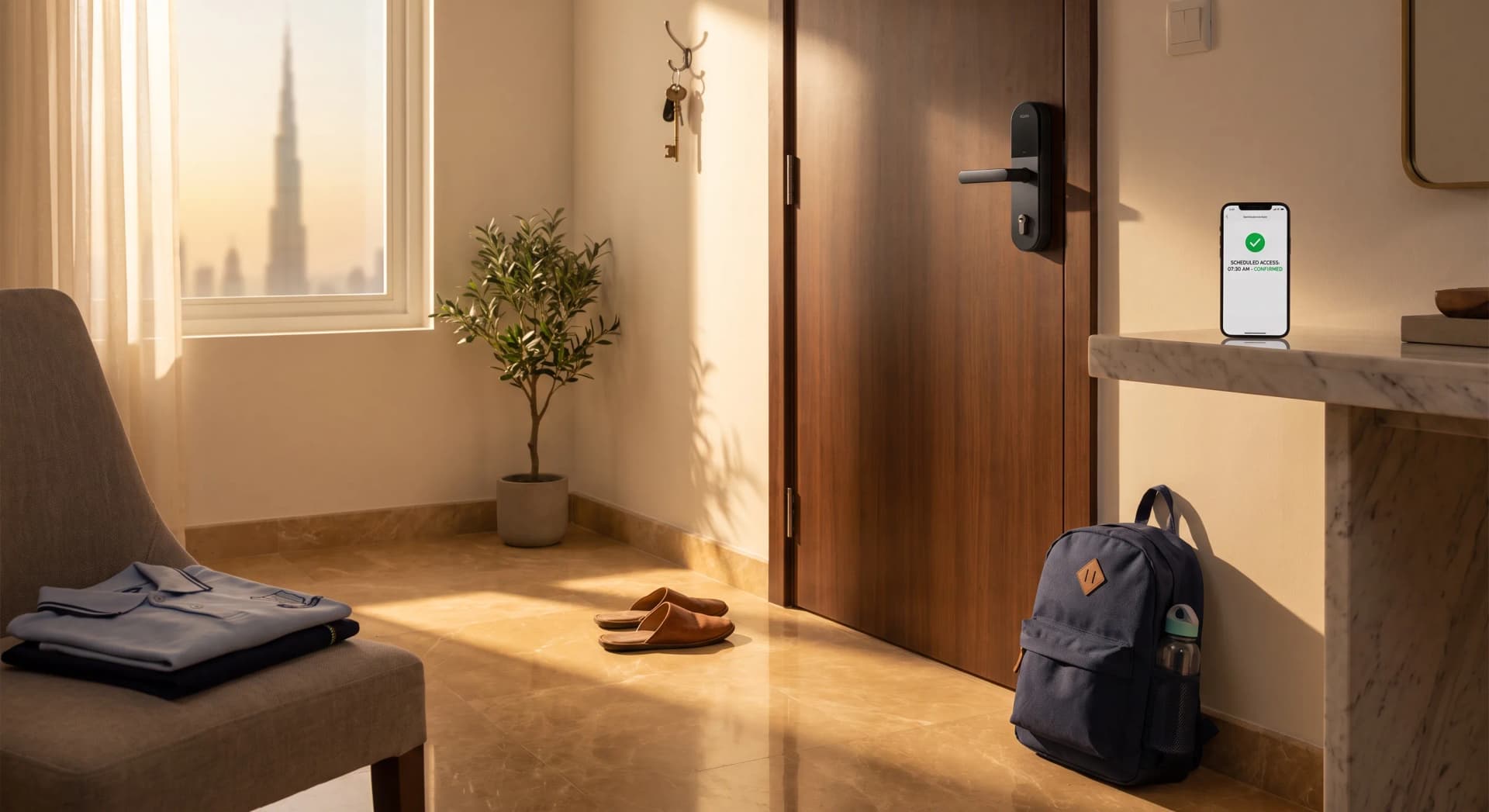
Most Dubai private schools return for the 2026-27 year on Monday, August 31 (Khaleej Times, 2026). That is five weeks out. It feels early to think about it. It is exactly the right week to think about it, because the household problem that shows up on day one is not one you can fix the night before.
TL;DR: The new school year does not move one wake-up time. It reinstates a five-day rhythm across the whole house at once: AC pre-cool, morning light, and who opens the front door for the school run, twice a day, every weekday. The part most families never plan is the last one. If a nanny, driver, or grandparent is doing pickup or drop-off, a shared key or a code nobody remembers gets rebuilt every term. A scheduled smart lock code fixes that for about AED 1,300, once, and it keeps working through the whole year.
Two prior posts on this site already cover pieces of the return to school. The six-device morning routine handles the 6:00-6:35am choreography, wake light through coffee plug. The kids' room lighting scenes handle bedtime, wake-up, and homework light in one room. Neither touches the part of a real school-term schedule that breaks first: the door.
Summer Runs on a Loose Clock
By late July, most households have quietly stopped enforcing anything. The AC schedule slipped weeks ago. Bedtime moved by an hour, then two. Someone is home most days, so the lights and the door get handled ad hoc, whoever is around, whenever it comes up.
In our experience, this is not a failure of discipline. It is the correct response to a loose season. The problem is that the new school year does not loosen back in gradually. It snaps to a fixed five-day pattern on day one, and every part of the house that drifted over summer has to catch up at once.
What the School Year Resets
A school morning is not one event. It is three schedules that have to move together, starting the same week, holding the same rhythm every weekday for the next ten months.
The wake-and-leave block covers roughly 6:00-7:15am: lights ramp warm to bright, the AC has already been running so the apartment is not fighting the morning heat, breakfast happens, backpacks get found. This is the territory the morning-routine post covers device by device, and it is worth reading if that hour is still fully manual in your home.
The homework-and-wind-down block covers the evening, roughly 4:00-9:00pm depending on the child's age: a brighter, cooler light for concentration, then a gradual shift toward warm and dim as bedtime approaches. The kids' room lighting post has the actual scene settings for this.
The third schedule is the one nobody writes a post about, because it is not a device list. It is access.
The Door Breaks First
Here is the moment that repeats in almost every household running a real school schedule. It is 7:04am on the first Monday back. The driver, or the nanny, or a grandparent covering the morning run, is standing at the door. Somebody is trying to remember whose spare key still works, or which four-digit code was last changed, or whether the cleaner's copy from March ever got collected back.
This is not a rare edge case. A live-in nanny in Dubai typically costs AED 1,500 to 4,000 a month, a live-out nanny AED 3,000 to 6,000, and even a part-time arrangement runs AED 30-70 an hour (NannyUAE, 2026). Households running a school-age schedule with two working parents very often have someone other than a parent handling at least one leg of the daily run. That person needs to get in and out of the home reliably, on a schedule, without a parent physically handing over a key every single day.
A shared key solves this the way most Dubai households solve it: badly, then quietly. Copies get made. Nobody remembers who has one. The locksmith visit to rekey the whole door only happens after something goes wrong, not before.
What a Scheduled Access Code Does
The fix is not a smarter key. It is removing the key from the equation for anyone who is not you.
Retrofit smart locks built for Dubai's euro-cylinder doors, the Aqara U100 kit runs about AED 1,299 installed (KanBkam, 2026), support more than one kind of code, and the distinction matters here. An always-on code works any time until you remove it, which is the wrong setting for someone who should only be in the home during a specific window. A recurring code only activates on the days and hours you set, for example weekdays 6:45-7:15am and 2:45-3:30pm, and does nothing outside that window. A temporary code works for a defined date range only, useful if a grandparent is covering drop-off for a two-week stretch while a driver is between jobs (Schlage, 2026).
Set a recurring code for the school-run window once, and it runs itself for the rest of the term. No key changes hands. No copy exists to lose track of. If the arrangement changes, one code gets deleted from the app and a new one gets added, both in under a minute, with no locksmith and no rekeying. What we have found installing these across Dubai households is that the schedule itself is the part families forget to plan, not the lock. The hardware is a ten-minute job. Deciding on the exact recurring window is the conversation worth having first. We have written about the mechanism behind these locks in more depth in how smart locks actually work in a Dubai home, including exactly how the motor engages your existing cylinder without replacing anything.
This is a different use case from the one-time PIN we cover for couriers, which is a single-use code for a single delivery. A recurring school-run code is the opposite pattern: the same window, repeating, for months on the same code.
Rebuilding the AC Schedule for a Five-Day Week
The AC schedule needs the same kind of reset, and it is a smaller job than the access piece because most controllers already support day-of-week logic. The setting that drifted over summer, an all-day run because someone was usually home, or a loose evening-only schedule, needs to go back to a fixed weekday pattern: a light daytime setback while the home is empty during school hours, then a pre-cool timed to land the apartment at temperature roughly fifteen minutes before the first person walks back in.
DEWA summer bills for a two-bedroom apartment typically run AED 600-1,000 a month, and AC accounts for 60-70% of that (DEWA, 2026). None of that is the headline here. The point of rebuilding the schedule is that the house stops needing anyone to remember it, not that the bill happens to land a little lower as a side effect.
Starting the Shift Two Weeks Early
Pediatric sleep guidance is consistent on this point: start adjusting bedtime and wake time about one to two weeks before the actual first day, in small 15 to 30 minute increments each night, rather than attempting the full shift the night before term starts (Children's Hospital of Philadelphia, 2026). With schools back August 31, the window to start that gradual shift opens in the second half of August, not this week.
Predictable routines are also linked to lower stress in children during a transition like this one, which is one more reason the reset is worth doing calmly over two weeks rather than scrambling through the first Monday.
What Bayora Will Tell You to Skip
Not everything marketed for this moment earns its place in a normal household.
A dedicated family-coordination app. Several exist, tracking who picked up whom and when. If your household genuinely needs that layer of tracking, it is a software decision separate from your home's automation and outside what we install. Most families do not need it just because the school year started.
An always-on code for household staff. It is easier to set up in the first five minutes and it is the exact habit that causes the March-cleaner's-code-still-works problem a year later. Recurring or temporary, every time.
A video doorbell as the whole solution. Seeing who is at the door is useful, but it does not replace scheduled access. You would still be unlocking it manually, with a better view first. Pair the two if you want both, but the lock schedule is the piece that removes the daily coordination.
Rebuilding everything the first week of September. The schedule shift works better started gradually from mid-August, and the access code takes ten minutes to set up any time before then. There is no reason to do either of these under time pressure.
Where to Start
If only one piece of this gets done before August 31, make it the access schedule. It is the one thing in this list that a family cannot patch with more attention or a better reminder, because the problem is structural: a shared physical key does not know what day or time it is. Everything else on this list, the AC setback, the light scene, the gradual bedtime shift, responds to a parent simply deciding to do it. The door does not, until it is set up once to know the schedule itself.
Frequently Asked Questions
When do Dubai schools go back in 2026?
Most Dubai private schools following the UK or IB curriculum return Monday, August 31, 2026, per the KHDA-approved academic calendar. Schools on the CBSE curriculum follow a different calendar, typically starting in April. Always confirm the exact date with your child's own school, since some allow limited flexibility within the approved calendar.
Can I set a smart lock code that only works during school hours?
Yes. Locks built around a scheduling feature support a recurring code type, active only on the days and hours you choose, for example weekday mornings and afternoons only. Outside that window, the code does nothing, which is the setting to use for a nanny, driver, or anyone covering the school run on a regular basis.
Is a smart lock renter-friendly, or does it require drilling?
Retrofit smart locks built for Dubai's euro-cylinder doors clamp onto the existing cylinder from the inside and turn it the same way your key does. Nothing is drilled or replaced, your original key keeps working, and the whole unit comes off and travels with you when you move.
What happens if the household arrangement changes mid-term?
One code gets deleted from the app and, if needed, a new one gets added in its place. There is no rekeying, no locksmith visit, and no risk that whoever had the old code retains access, because that code simply stops working the moment it is removed.
Do I need to change anything about the AC schedule specifically for a five-day school week, or does it handle itself?
Most smart AC controllers support day-of-week scheduling, but the schedule itself has to be rebuilt after a summer where it likely ran on a looser pattern. A weekday setback while the home is empty, followed by a pre-cool timed to the first arrival, is the setting to reinstate before the first Monday back.
The wake light and the homework scene are already solved problems on this site. The door is the one that quietly resets itself to badly-managed every September, in almost every household running a real school-term schedule. Get in touch and we will look at what your home needs before August 31, not everything on this list, only the part that fits your household.
Ready to Get Started?
Get a free consultation and we'll recommend what makes sense for your situation.
Get Free Consultation