The quote runs to four pages. Somewhere on the second one, in among the keypads and the dimming actuators and a lot of part numbers, is a line called a server. It is one of the more expensive things on the list. It is also the only line nobody walked you through.
You are allowed to ask what it does. Most people don't, because asking about one line feels like admitting you did not follow the other three pages either. So it gets approved along with everything else.
TL;DR: A KNX system works without a server. The bus is decentralised, so a keypad talks straight to the actuator driving your light and keeps doing it with no server, no hub and no internet. Scenes and even weekly sunrise schedules run on ordinary bus devices. The server buys you voice control, phone access, logic across multiple devices, and anything that isn't KNX.
KNX Was Designed So the Lights Work Without a Server
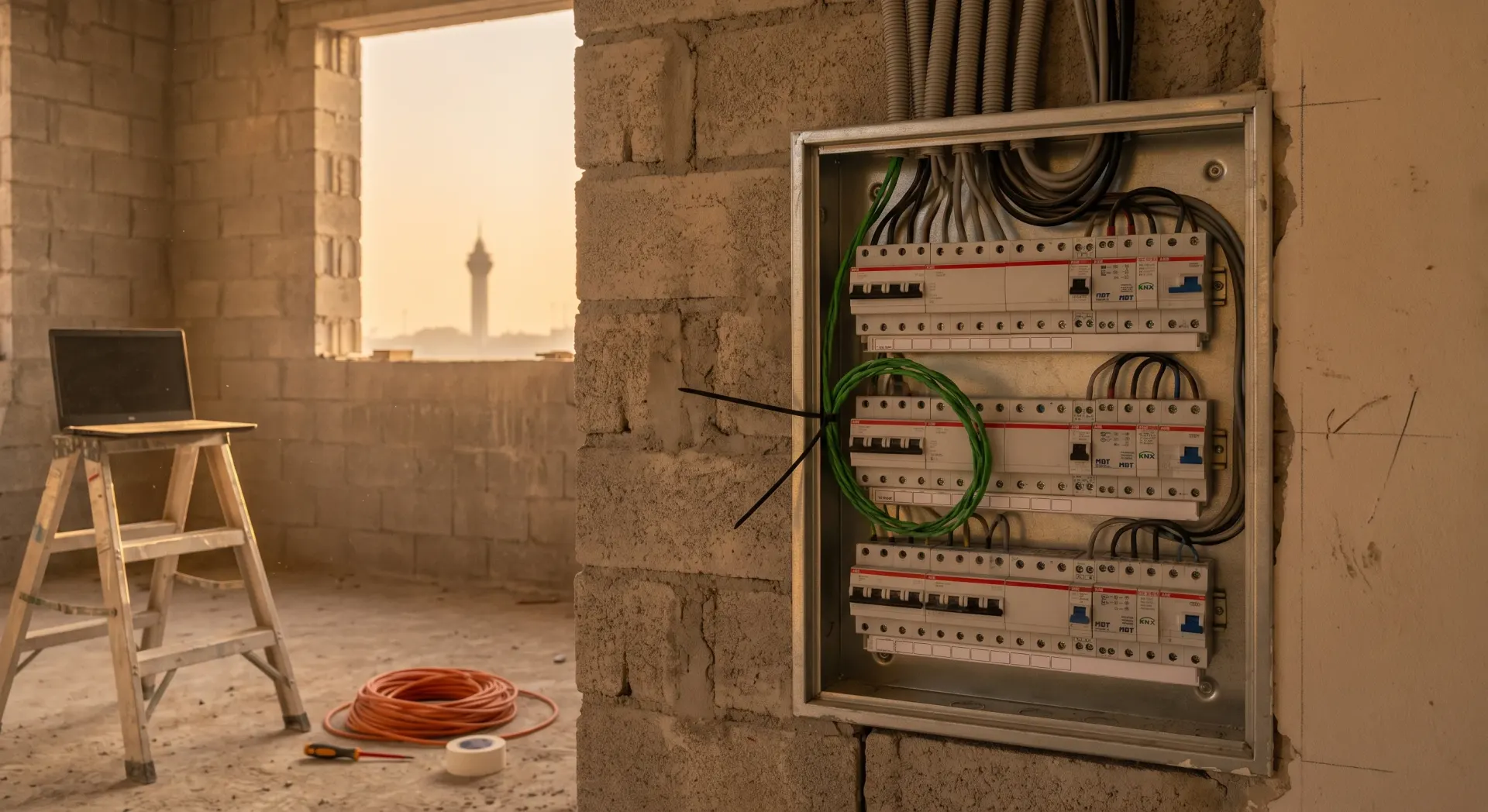
There is no central brain in a KNX installation. Every device on the bus, every keypad, actuator and sensor, carries its own configuration and talks directly to the others over a two-wire cable.
The KNX Association puts it plainly in its own comparison of distributed and centralised systems: "Each device communicates with others, contrary to a central hub, where only one device steers a connected network" (KNX Association, 2024). The same page describes the consequence that matters to you: "The interconnectivity of distributed systems allows for a resilient smart home set-up as there's no single point of failure. If one device malfunctions or loses their connection, the others carry on without error."
Read that as a builder rather than an engineer. Press the keypad by your front door and the actuator in the panel closes the circuit. Nothing in that chain routes through a server, a cloud account or your router.
The Three Boxes People Call a Server
Three different products get called "the server": a KNX IP interface, a KNX IP router, and a visualisation server. Only the last one carries features you will ever touch, and only the last one is expensive enough to argue about.
A KNX IP interface is a commissioning tool. Weinzierl describes its 731 as a device that "can be used as programming interface for ETS Software", letting you "access the KNX Bus from every point of your LAN" (Weinzierl). It is how your integrator programs the system. It adds no features you will ever see.
A KNX IP router is plumbing. Weinzierl's 752 "enables the secure forwarding (routing) of telegrams between different lines over a LAN (IP, Ethernet) as a fast backbone" (Weinzierl). Large villas get split into several bus lines, and the router joins them. Still no features.
A visualisation server is the real one. Gira describes its HomeServer as "the on-board computer for the intelligent building" that "connects the electrical installation for the KNX system with the computer network and the internet" (Gira). That is the line worth questioning.
The Bus Already Runs Scenes and Schedules
The two things people most often buy a server for are already sitting in the panel.
Scenes run on the actuator. MDT's 16-fold switch actuator datasheet lists "Extended logic and scene function per channel" alongside "Time functions (switch on-/switch off delay, staircase light function)", on a device with 16 outputs rated 16 A each (MDT). Your "everything off" keypad button is a scene stored on hardware, not a program running on a computer.
Time schedules run on a dedicated bus module. MDT's KNX Time Switch is a "Time Switch with 20 channels (8 switch times for each channel)" with "Day- / week- / astro switching function, power reserve" and "Automatic holiday calculation" (MDT). Astro means it tracks sunrise and sunset by date, which in Dubai moves the useful blind-closing time by well over an hour between December and June.
So "I want the blinds to close at sunset" is not, by itself, a reason to buy a server. Ask your integrator whether the schedules keep running when the internet drops. On a bus device, they do.
What the Server Genuinely Buys You
Four things need the server: logic that spans several devices, control from your phone, anything that is not KNX, and consumption history. Pay for the ones you will use and skip the rest.
Logic that spans several devices. A single actuator handles its own channels. Chaining conditions across the blind position, an outdoor sensor and the time of day needs somewhere to hold that logic, which is what Gira means by its "graphic logic editor".
Control from your phone rather than from the wall. A bare KNX bus has no connection to the outside world at all. If you want to change the study setpoint from the kitchen without walking to a keypad, that path goes through the server.
Anything that is not KNX. Gira lists "straightforward integration of a large number of technologies such as door intercoms, cameras, audio systems and third-party systems". Your cameras and your intercom are not on the bus, and something has to introduce them.
Consumption visibility. Gira says its energy module "clearly displays all the consumption values at any time", which describes a live readout rather than months of trend history. If you want the history, confirm it with your integrator instead of assuming the server does it.
What Breaks When the Internet Drops
One thing to raise with your integrator before you sign. The wall controls stay local either way, but the phone and voice legs generally reach you through the manufacturer's own remote-access service, so ask which parts of the system carry an ongoing dependency and which do not before you sign.
Voice Control Is a Server Feature
The KNX bus carries no voice layer of its own, so the assistant sitting in your kitchen has no way to reach a light on the bus directly. It goes through the server or it does not happen.
Gira is explicit about the route: "If you choose a KNX system, you can control building functions via the Gira X1 server or the Gira HomeServer", after which "all functions can be activated or deactivated using the relevant voice commands through Amazon Alexa or Google Assistant" (Gira). On the X1, the remote and voice legs are gated behind a further companion module, so the real answer to "can KNX do voice" is yes, through two more products.
This matters when you are comparing a KNX quote against a wireless one. Voice comes free with most wireless kit and costs a hardware line on KNX. That is a fair trade for a system designed to keep working when the internet does not, but it should be a decision rather than a surprise.
Where the Cost Sits in a KNX Quote
Channels move the number. Floor area and bedroom count barely register, and neither does the server.
An actuator is a per-channel device. MDT says so in its own sales copy: the range "offers more channels with less space requirement, which minimises costs per channel and for the distribution board". Every circuit you want switched or dimmed independently consumes a channel, so a villa with a lot of small lighting circuits costs more than a larger one with fewer.
The other line people miss is software. ETS is, in the Association's words, "the single software tool used to plan and configure KNX projects", and licences run EUR 200 for the Lite tier capped at 20 products, EUR 350 for Home capped at 64 devices, and EUR 1,000 for Professional with no cap (KNX). Worth knowing before someone quotes you a "programming fee" with no basis.
On certification, the Association's own answer is more useful than the marketing on either side: "No, certification is not mandatory - but it is strongly recommended" (KNX).
Your Dubai AC Needs Its Own Gateway Either Way
KNX does not speak to your air conditioning out of the box, and this catches people in Dubai more than anywhere else because cooling is the biggest thing the system will ever control.
Every split, ducted unit or fan coil needs a brand-specific gateway to join the bus. Intesis, owned by HMS Networks, builds its entire AC gateway line around exactly this problem and lists 22 compatible HVAC manufacturers, including Daikin, Mitsubishi Electric, Mitsubishi Heavy Industries, Samsung, LG, Midea, Hisense, Gree, Toshiba and Carrier (HMS Networks). Those are the brands mounted on Dubai walls.
Two things follow. A quote with no AC gateway line has not priced climate control, whatever the covering note says. And on the standard domestic splits and ducted units in most Dubai villas, gateways run close to one per indoor unit, so fourteen zones means roughly fourteen of them. Centrally ducted and VRF systems are the exception, because a single larger gateway can carry many indoor units, so ask which kind you have before you accept a count. None of this changes if you skip the server. We cover the control side in more depth on our smart AC page.
Almost Nobody in Dubai Will Publish a KNX Price
You will find a lot of AED ranges for KNX villas online. We went looking for where any of them come from and could not find a source for a single one.
Schneider Electric's own UAE web shop lists real KNX part numbers and then says "To View the best prices please Sign in / Register". Search a local distributor's site for KNX by category and it returns no products at all. One competitor's UAE cost calculator publishes confident figures and then concedes, in its own words, that a pricing conversation without a site visit could be off by as much as 40 per cent in either direction.
One real published number does exist. A Dubai distributor lists the 1Home Server KNX Pro, a product in exactly the category this article is about, at AED 4,999. That is one box from one vendor rather than the price of your system, but it puts an order of magnitude on the line you are being asked to approve, which is more than any of the ranges manage.
What we have found is that every published whole-system range is somebody's guess wearing a decimal point. We are not going to add another one. Two of our own older posts quote a villa KNX range we cannot source either, and they are being corrected. If a number matters to you, it comes from a channel count and a device schedule, and that needs somebody in the house.
What Bayora Will Talk You Out Of
We will talk you out of a server on a house where nobody wants voice or phone control. If the ask is switching, dimming, scenes on the keypads and blinds that follow the sun, the bus does all of it, and the server becomes an expensive box that mostly logs things nobody reads.
We will talk you out of buying one to solve scheduling. That is what the time switch module is for, at a fraction of the cost.
We will also talk you out of the opposite mistake. If you want Alexa, a floor plan on your phone, your intercom and cameras in one place, or logic that reasons across several rooms, the server is the right purchase and a cheaper quote without one is not a saving. It is a different system.
The One We Push Back On
We will also push back on anyone telling you KNX is impossible in a finished home. The wired bus does want its cable pulled before the walls close, which is the honest constraint. Wireless and powerline variants of KNX exist for retrofits, though they carry their own trade-offs and are a different conversation from the one your quote is describing. We wrote about the broader choice in wired versus wireless for Dubai homes, and about picking a platform in KNX versus Home Assistant.
Frequently Asked Questions
Do I need a KNX server?
Ask whether it can be added later, because that changes the decision. The bus already works without one, so a server is normally an addition to the panel rather than something the cabling has to anticipate. If you are unsure, the lower-risk order is to live with the system first and add the server once you know which of its features you actually reach for.
What is the difference between a KNX IP interface and a KNX IP router?
An interface is the easiest way to keep programming access without a laptop plugged into the panel, though a small single-line villa can be commissioned over USB with nothing permanent installed. A router only earns its place once the installation is big enough to be split across multiple bus lines. A small villa on a single line does not need one, so if a router appears on a modest quote, ask what it is coupling.
Can KNX work with Alexa or Google Assistant?
Yes, through a server product. When your connection drops, voice commands stop, because they travel out to the assistant's service and back. Your keypads, scenes and schedules carry on untouched. Voice is a convenience layer over the system rather than the way the system runs.
Do I need ETS software to change my KNX system?
For reconfiguring devices, yes. The more useful question is who holds a copy of your ETS project file. Ask for one at handover and store it yourself, so whoever works on the system next has the record of how it was set up.
Does KNX work with my Daikin AC in Dubai?
Through a gateway matched to the brand. Intesis publishes them for 22 HVAC manufacturers, and also lists a universal infrared option for units outside that set, so an unusual brand is awkward rather than fatal. Count them against your indoor units when you read the quote, because climate has not been priced without them.
Reading Your Own Quote
Find the server line and check which of the three boxes it is. Vendors each use their own naming, so the word on your quote may be a brand name rather than the word server, and the fastest way through it is to ask which of the three jobs the box does: programming access, joining bus lines, or visualisation and logic. Only the third one has features attached.
Then ask for the quote priced both ways, with the server and without it. That single request tells you what the box costs in your specific house, which is the number no article can give you, and it makes the trade-off visible instead of leaving it buried on page two. Ask us and we will price it both ways, because the answer changes with what the household actually wants.
If you want a second pair of eyes on a KNX quote, or a straight answer about whether wired is right for your home at all, talk to us. We will tell you when it isn't. We also work with KNX and Home Assistant, so we have no reason to push you toward either one.
Ready to Get Started?
Get a free consultation and we'll recommend what makes sense for your situation.
Get Free Consultation